When I first found out that my father had been a POW in PG 49 at Fontanellato I immediately recalled that, during my childhood, he had briefly talked about living in the hills with an Italian family during a brief period of his wartime experience. But I knew nothing of how this had come about and so it is only when I come across some of the incredible stories archived by the Monte San Martino Trust written by others who were in the same Camp that I start to fully appreciate exactly when and how these events unfolded.
One such story is written by Lieutenant T.D. Vickers of the Coldstream Guards –
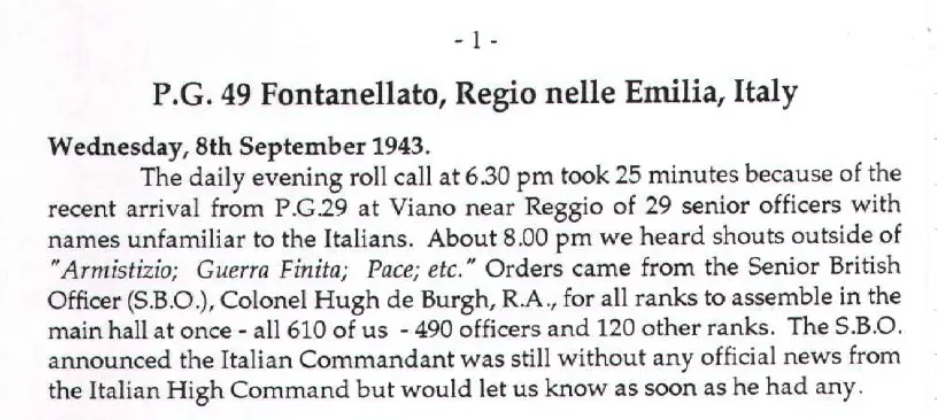
Wednesday, 8th September 1943
“The daily evening roll call at 6.30 p.m. took 25 minutes because of the recent arrival from P.G.29 at Viano near Reggio of 29 senior officers with names unfamiliar to the Italians….”
Could this possibly be connected with the 27 Indian Army officers shown on page 220 of the 267 pages of WO 392/21?
Thursday, 9th September 1943
“After breakfast we were all told to parade in the courtyard. This time the SBO’s news was not so good: the Commandant expected German troops to seize the camp. He had patrols out. We were to put on our battledress, pack our kit on our beds, draw 24-hour rations and be ready to move at five minutes’ notice. He had offered our help to defend the camp but the Commandant had politely declined it.
I left my greatcoat and service dress uniform in the wardrobe of Room 63 and packed only washing and shaving kit, a pullover, scarf, gloves and some letters and family photographs. From the basement I collected my emergency rations – a tin of service biscuits, a meat roll, 2 peaches and a small bar of ‘Motta’ chocolate. I also took the remains of my Red Cross food parcel – sugar, cocoa, nescafe and a large bar of chocolate – and some cigarettes for barter. During the morning Colonel Hugh Mainwaring, RA (one of the 20 Old Etonians in Fontanellato) and Captain Prevedini, the camp’s Italian security officer and interpreter, returned from their two-hour recce for a suitable hide-out. It seemed strange to see the latter, an ambivalent character, on our side.
Before the war he was on the staff of Thomas Cook and spoke fluent English.”

The next paragraph produces some fascinating information, and the introductory sentence brings a smile to my face. My Dad’s favourite Sunday lunchtime drink was Gin and Dubonnet (I know it was the Queen Mother’s too!).
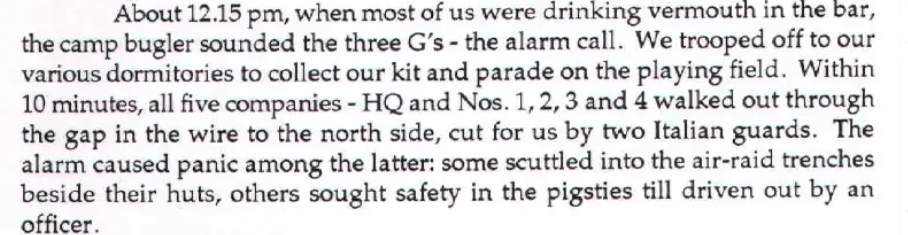
The diary entry then goes on to explain in great detail with whom Tom was linked up with as they marched out of the camp:-
“I was in No. 3 company, commanded by Lt. Colonel Peter Burne, 12th Lancers.
My platoon commander was Major Donald Nott, D.S.O. M.C., of the Worcesters.
Captain Ronnie Orr-Ewing (2nd Bn Scots Guards) was my section commander.
Each section was in pairs – our’s were Ronnie and Philip Kindersley (2nd Coldstream);
Jack Younger (3rd Coldstream) and Richard Brooke (2nd Scots Guards);
Carol Mather (Welsh Guards) and Desmond Buchanan (Grenadiers);
and finally, Tony Kinsman (Grenadiers) and myself (3rd Coldstream).
Between No. 3 Co. and No. 4 on our right rode Eric Newby in his Black Watch bonnet, riding on a fat horse led by an Italian soldier. Eric had fallen and broken his ankle two days earlier and could not walk.
We crossed fields and vineyards and caught up with the SBO and his HQ party, moving on then into a sunken ditch below a grass bank and in thick undergrowth. This was the site chosen by Hugh Mainwaring.
We spent the afternoon drying our sweaty shirts, eating grapes and waiting for news and orders.”
I’m licking my lips. So much information! And it looks like there’s more to come because a few days later ……
“The road was below us and beyond it the river with hamlets dotted over the opposite hillsides. A guide took us round the steep Rocca Varsi and showed us the collar we had to make for and the church spire at Tosca. Just short of the church we came across a bullock sledge cart full of maize cobs. (There were no wheeled vehicles on those steep, rock paths). The cart blocked the path and the peasant and his wife were busy picking the cobs in the adjoining field. Both were friendly and gave us grapes. His name was Bernardo Gianelli. He had worked as a vegetable cook at the Cecil and the Savoy Hotels in London before the war.”
 PG 49 at Fontanellato in Italy - The Story of allied servicemen who were held prisoner of war in this town in Italy in World War II