Since I first started reading stories about Prisoners of War in Prigione di Guerra (PG) 49 at Fontanellato I was immediately aware that, if it had not been for one very important person, the whole story of the POW’s at this camp would have been very different. And, in making the decision (some might argue having been persuaded to make this decision) to release the POW’s into the Italian countryside after the Armistice, Colonel Eugenio Vicedomini paid the ultimate price. For that reason alone I have always felt that this man was a true hero.
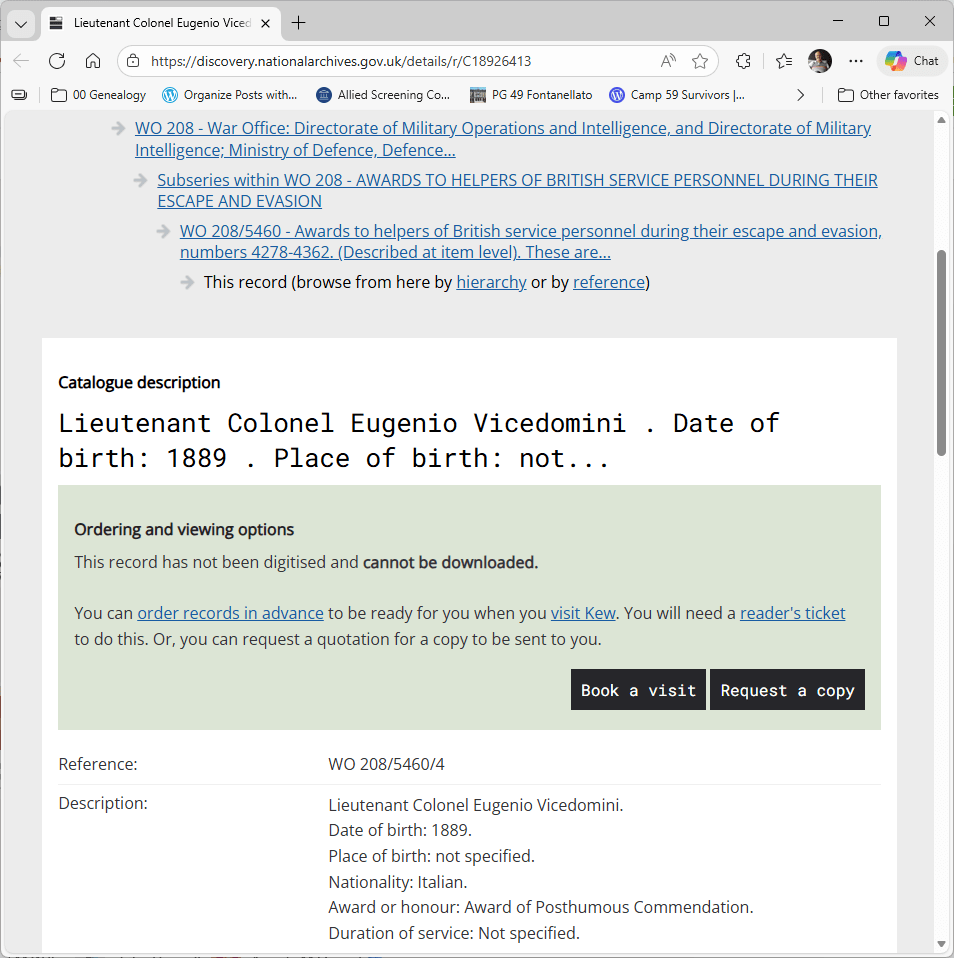
And yet there is very little information about him. Yes, I have established that there are a number of records about him that appear after his death, notably record WO 208/5460 at the National Archives which indicates that he was born in 1889. Unfortunately, like many other documents I unearth at the National Archives, the record has not been digitised and cannot be downloaded.
And a record attributed to Colonel Hugo de Burgh, the Senior British Officer (S.B.O.) at PG 49 and who was also Commanding Officer of the Allied Screening Commission (A.S.C.) in Italy after World War 2, indicates that he had been “…. able to obtain for this gallant gentleman a military funeral attended by British Generals…”. So far I haven’t been able to find any details about this or his life prior to WWII but there are a number of documents and passages in books and stories told by POW’s that provide an insight into the type of man he was.
None more so than the document that provided the quote above which had been some typewritten notes of a talk that Colonel de Burgh must have given whilst working for the (A.S.C.) entitled “Switzerland Invaded” which shed some light on the thousands of people that escaped German Occupation by fleeing to the neutral status of Switzerland. A goal that my father rather sadly did not achieve as he was arrested, according to my brother Graham, after crossing the border into Switzerland after his release from PG 49.
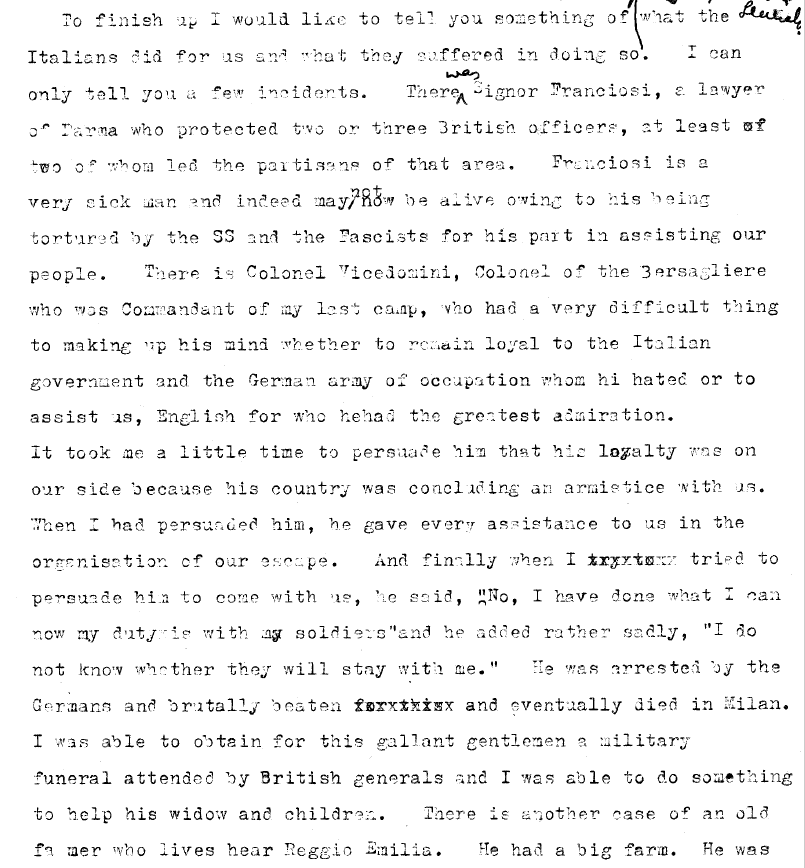
“There is Colonel Vicedomini, Colonel of the Bersagliere who was Commandant of my last camp, who had a very difficult thing to making up his mind whether to remain loyal to the Italian government and the German army of occupation whom he hated or to assist us, English for who he had the greatest admiration.” (I’m sure I’ve read somewhere that he had fought alongside the British in World War 1: see Allies in Italy – Hugh Mainwaring)
” It took me a little time to persuade him, he gave every assistance to us in the organisation of our escape. And finally when I tried to persuade him to come with us, he said ‘No, I have done what I can now my duty is with my soldiers’ and he added rather sadly ‘I do not know whether they will stay with me.’ He was arrested by the Germans and brutally beaten and eventually died in Milan.” …. after being released from Mauthausen Concentration Camp in Austria after the war.
“I was able to obtain for this gallant gentleman a military funeral attended by British generals and I was able to do something to help his widow and children.”
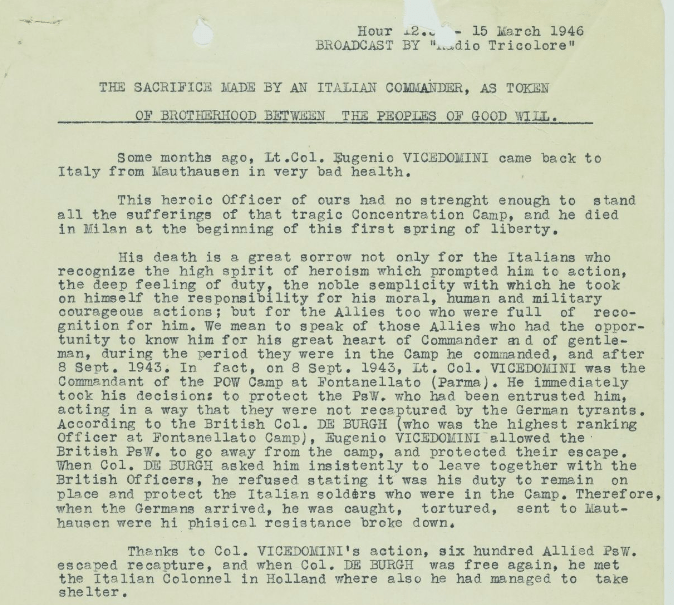
Another document that I stumbled upon was a record found on The National Archives and Records Administration (N.A.R.A.) website which provided a transcript of a Broadcast made on 15th March 1946 entitled “THE SACRIFICE MADE BY AN ITALIAN COMMANDER, AS TOKEN OF BROTHERHOOD BETWEEN THE PEOPLES OF GOOD WILL.”
A further screenshot was taken from the same document found on the Monte San Martino Trust website that provides a Summary of Hugo de Burgh which was written by Giuseppe Sambataro and listed as an undated account of the general exit from Fontanellato.
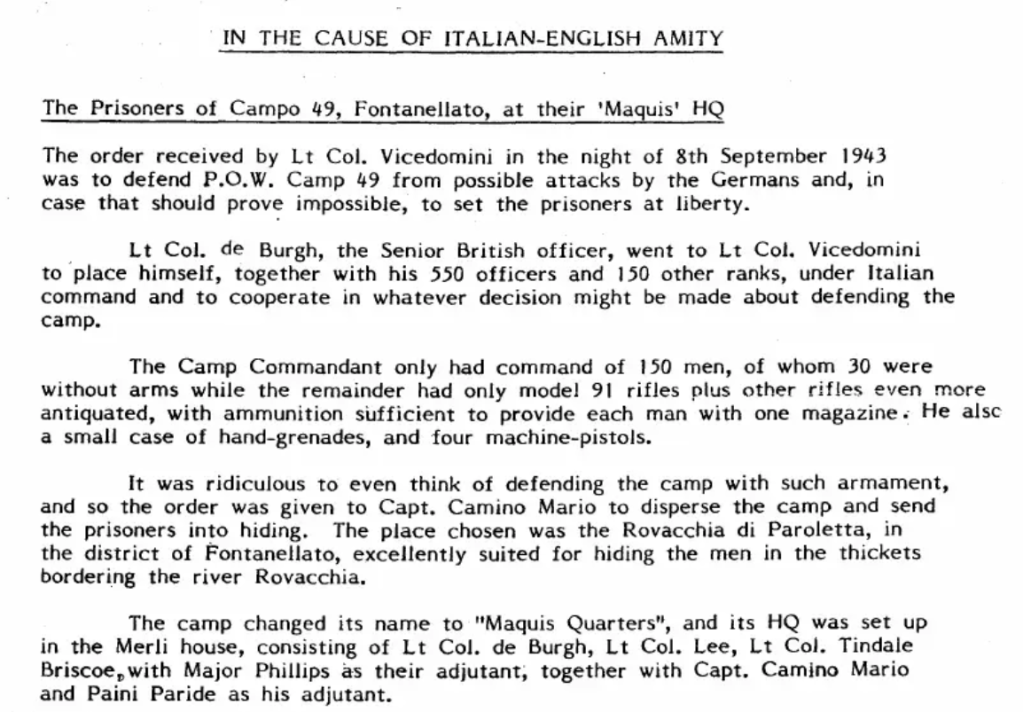
“The order received by Lieutenant-Colonel Vicedomini in the night of 8th September 1943 was to defend P.O.W. Camp 49 from possible attacks by the Germans and, in case that should prove impossible, to set the prisoners at liberty.
Lieutenant-Colonel de Burgh, the Senior British officer, went to Lieutenant-Colonel Vicedomini to place himself, together with his 550 officers and 150 other ranks, under Italian command and to cooperate in whatever decision might be made about defending the camp.
The Camp Commandant only had command of 150 men, of whom 30 were without arms while the remainder had only model 91 rifles plus other rifles even more antiquated, with ammunition sufficient to provide each man with one magazine. He also a small case of hand-grenades, and four machine-pistols.
It was ridiculous to even think of defending the camp with such armament, and so the order was given to Captain Camino Mario to disperse the camp and send the prisoners into hiding. The place chosen was the Rovacchia di Paroletta, in the district of Fontanellato, excellently suited for hiding the men in the thickets bordering the river Rovacchia.”
The National Archives themselves created a Blog about “Leaving the Italian prisoner of war camp Fontanellato“
Another factor in the confusion was the British War Office’s instruction to prisoners of war to stay put. By contrast the Badoglio Government instructed camp commanders to let the prisoners of war out, an instruction many camp commanders obeyed, whilst some did not. In Fontanellato, the Italian Commander, Colonello Vicedomini, defied the Germans and released the prisoners of war. For this act he was sent to a German concentration camp.
 PG 49 at Fontanellato in Italy - The Story of allied servicemen who were held prisoner of war in this town in Italy in World War II