A brief history of events that shapped this period in his life supported by papers belonging to his wife:-
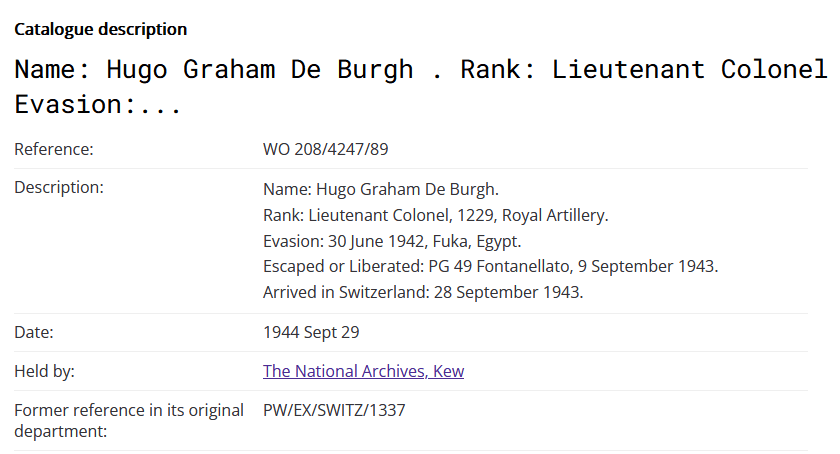
1942 June 30th – Captured at Fuka, Egypt in North Africa
1942 July 15th to November 28th – S.B.O. at P.G. 75 at Bari in Italy
1942 November 29th to 1943 March 17th – S.B.O. at P.G. 38 at Poppi in Italy
1943 March 17th to August 8th – S.B.O. at P.G. 202 in Lucca Hospital (for 5 months)
1943 August 8th – P.G. 49 arrived at Fontanellato
1943 September 9th – escaped or liberated from P.G. 49 at Fontanellato
1943 September 28th – arrived in Switzerland
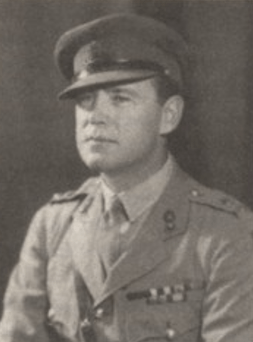
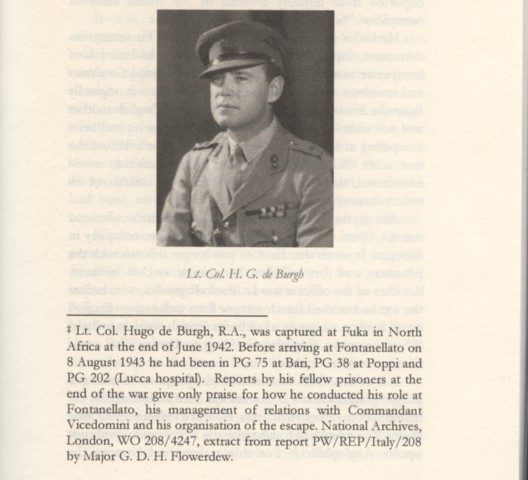
From all the research I have undertaken thus far I have never come across any criticism of this man who, as Lieutenant Colonel, 1229, Royal Artillery, became the Senior British Officer (S.B.O.) at P.G. 49 in Fontanellato after his arrival there on 8th August, 1943. One of the finest examples of this is contained in some letters exchanged between his son and a Major General R.H.L. Wheeler C.B., C.B.E. who I have listed in my Roll Call as being in P.G. 21 and a Lt. Col. (34344) in the Royal Artllery who referred to his S.B.O. as G. de B. or Graham de Burgh and who G. de B. appointed as his ‘Intelligence Officer’.
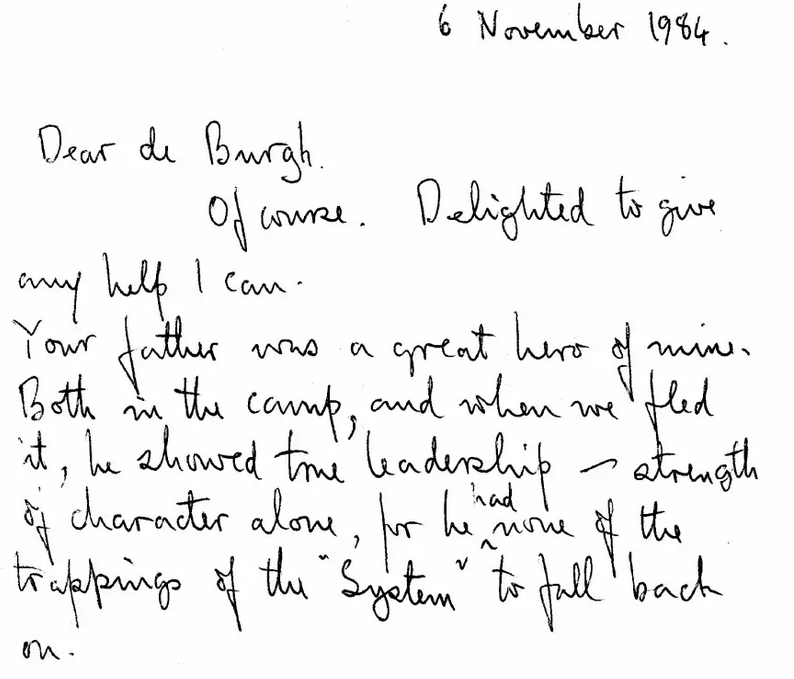
[Handwritten letter from Major-General R.H.L Wheeler to Hugo de Burgh’s son dated 6th November 1984]
Dear de Burgh, Of course. Delighted to give any help I can. Your father was a great hero of mine. Both in the camp, and when we fled it, he showed true leadership – strength of character alone, for he had none of the trappings of the “System” to fall back on.
The letter went on to say….
“I will send you a few notes, and if they cover what you have in mind we can go on from there. Delighted to see you if you feel it necessary. One delicate point, confidential to you for the moment. Messages had been received by most camps that we should stay put and await the Allied troops. Some camps did so and were swept up by the Germans. Graham would have none of this and led us forth, disobeying the order. Would officialdom take exception to disclosing this message system. It was ridiculous anyway. Yours sincerely Richard Wheeler
In all there were many letters exchanged between the two and in conclusion there were the following documents:-
1/ A seemingly official report by above on Colonel de Bergh (sic) for whom he was ‘Intelligence Officer’ at Font(anellato). He emphasises in this and correspondence with H. de Brugh (sic) jun how de Burgh smartened up the inmates of the Camp, made them respect the Italians and generally boosted morale and paved the way for the orderly exit from the Camp. 2/ General Report on Camp, inmates, escapes etc. 3/ Replies to queries by H de B. 4/ Extracts from other reports on de B. Official Report of de B.’s capture, de B. in hospital at the Lucca Hospital for POWs for 5 months. 5/ List of Italian Personnel. Commandant and Interpreter very pro (English). 6/ Helped to Milan by individual /British. (H de Burgh). 7/ Undated account of the general exit from Fontanellato by luseppe Sambataro.
The notes he provided in 1/ above on the seemingly official report on Fontanellato (part of which I have included below) provides us with a great insight into P.G. 49 both before and after Hugo de Burgh’s arrival at the Camp.
P.G. 49 Fontanellato
Said to have been a nunnery. Good buildings. Large number of smallish rooms – 8/10 officers in each. Central hall (big) where we hold plays, concerts etc. Central dining room. Big sandy exercise area.
Perhaps 400 officers with 100 O.R. [Other Ranks] as orderlies etc. Fantastic variety – city men, priests, dentists, doctors, regular soldiers; John de Bendern (amateur golf champion) who walked around with a teapot full of chianti; Bragg a Wing-Commander who swam ashore over a mile after being shot down, had never swam more than 50 yards before. Donald Pain, Beaufighter pilot; Donald Nott regular Worcesters DSO [Distinguished Service Order] MC [Military Cross], etc. etc. (See Eric Newby’s books especially Love & War in the Apennines).
Doctors worked out the calorie intake was so low that we should hardly move. But fitness was a shibboleth. Walking round wire every evening (anti-clockwise); running up & down stairs; athletic meetings (Cavalry vs R.A.F. [Royal Air Force] etc.) P.T. [Physical Training] classes led by Roncaroin (International Rugger player) especially using a towel for stretching work.
Education classes on every possible subject. Bridge, sometimes all day. Poker schools for very high stakes indeed, through I.O.U’s. Language classes.
No discipline, slovenly dress. Beardo. A great deal of sunbathing, naked, “Roll Over” an uproar.
Entry of G. de B. from hospital. Took over S.B.O. (Senior British Officer) immediately; claiming a small bed/sitting room for himself. Very trim in desert gear; and slacks, battle dress jacket, polka-dot scarf, tidy hat, small metal rank badges. Walked round whole camp, silent, eyebrows raised, inimitable half smile of quizzical outrage which said “Yes, I understand, but this will all stop immediately”.
He organised the whole camp into Coy’s [Company], commanded by Lt/Cols [Lieutenant-Colonel]. Appointed an Adjutant (and me as his Intelligence Officer) and/or G1 [General Staff Officer Grade 1]. Roll-calls we had to fall in properly dressed; no talking. Nudity was forbidden. All beards to be shaved immediately (save for Naval Officers) I had to arrange an officer who said he had become a Sikh to be forcibly shaved (G de B cross questioned and defeated him on the Sikh religion).
He forbade walks outside the camp after some officers had pelted a troop lorry with tomatoes.
Established close liaison with Camp Commandant when it was clear (through venial guards we had bribed) that Italy was breaking up.
Finally had us making some change in our dress for dinner.
And yet my father never talked about him? I’m now wondering if he was the officer claiming he had become a Sikh as I’m pretty sure he was the only POW in the camp who was in the 11th Sikh Regiment!!
But my father did speak of the kindness and generosity of the Italian family (or even families?) he was sheltered by, especially the one he spent quite some time with in the mountains, even helping to tread the grapes during the wine harvest. Also the difficulty he had not knowing which Italians he could trust as many were still firmly fascist and supporters of the Nazi regime.
He also spoke briefly about his time in Milan prison, intimating that he was threatened with being shot as a spy and witnessing some who were, after he had been re-captured by the Germans. My brother Graham contributed a chapter for a book commemorating his School’s unbeaten Rugby XV, explaining that….
“He (our father) was captured a third time trying to cross into Switzerland, this time in civilian clothes and, as a spy, was sent to a civil prison in Milan. After a month of witnessing from his solitary cell daily executions by firing squad in the prison courtyard he was finally reprieved and sent to a POW camp in Germany. When liberated he returned to England weighing just eight stone, and when he met my mother for the first time she described him as looking like a monkey.“
But back to Hugo De Burgh we find that Marco Minardi in his book describes him as “Strict but reasonable, de Burgh demanded discipline and dignity from everybody“.
Extract from “Bugle Call to Freedom” by Marco Minardi.
But without the decision making of Lt. Col. H.G. de Burgh, as well as his ability to work closely with the Italian authorities at the time of the Italian Armistice in September 1943, my father’s story would have been very different. As made clear with the “Summary of Hugo de Burgh” headlined in The Post published by the Monte San Martino Trust Archive:-
Summary of Hugo de Burgh
“Hugo de Burgh was a Lieutenant-Colonel, a PoW and the SBO [Senior British Officer] in Camp 49 Fontanellato. After WW2 he was Head of the Allied Screening Commission, where he travelled extensively throughout Italy trying to track down the Italian people that gave assistance to escaping British POWs so that they could be officially recognised by the British Government.
His story details his work across these areas, improving the mental fitness of the British soldiers in the camp to prepare them for any escape attempt that might be coming in the future, liaising with the Italian Prison Commandant, arranging the escape from the camp after the Italian Armistice and himself escaping to Switzerland after a perilous journey through the mountains from northern Italy. His escape is detailed in Blackwood’s Magazine Issue 1561, along with other articles in the Radio Times and New Statesman magazine, which are all included here.
With thanks also to The National Archives for their permission to use the PoW reports for Hugo de Burgh and Noel Burdett.”
Examples of this information included:-
BRIEF CIRCUMSTANCES OF CAPTURE: Moved with Regiment with 10 Corps from Sidi Haneish. Stopped on scarp to see Regiment through. German tanks worked round to East of Column and opened fire on Column. Considerable confusion. Got through leading a few trucks. Truck gave out. Walked desert. Picked up by 3 Ton truck early next morning. Met Bays and Armoured Cars of Royals? Went on their advice through mine field to Division H.Q [Head Quarters] German Patrol in trucks opened fire, some wounded. Impossible get away with overloaded 3 Ton Lorry from small fast vehicles heavily armed, we practically unarmed.
Before I left LUCCA there had been rumours of prisoners being sent to Germany. On arrival at FONTANELLATO I superimposed a Company organisation upon the ordinary Dormitory organisation. This Company organisation was designed to meet any eventuality. See Appendix C.
On the 5th Sept. 1943 the Italian Commandant informed me that Germans had intimated that prisoners were to. be removed to Germany. I asked him what he intended to do, and if he was prepared to give us some warning. He replied that he would, and that if I organised, or was organised, inside the wire, he would have cyclists out to bring information of any approach of German troops. I saw him again several times about the question of our getting away, and on the 8th Sept., 44, he allowed me to send my G.1 [General Staff Officer Grade 1] with an Italian officer to reconnoitre an area suggested by him, and agreed to by me, where we could hide the whole camp, some 600 all ranks, (Officers and O.R. [Other Ranks] servants) for a short time. No organisation was in existence other than this and certain individuals.
On 9th Sept. I was warned at 12 noon that we were to leave. Having organised beforehand and packed and dressed in battledress, rations were issued for 24 hours. The Italian officers cut the wire. We formed up in 5 Companies and H.Q. [Head Quarters], on the recreation ground and marched to concentration area. The Camp was cleared at 12.10. Each Company and H.Q. [Head Quarters], were guided to Areas under cover, and remained that night, as we had no information of Germans except that they had arrived in the Camp one hour after we had left and arrested the Italian Commandant and some other Italian personnel. They had broken open everything and given many food parcels to the local population. The population brought most of it to us in hiding. The Italian officers and certain civilians collected civilian clothes and as many as possible changed out of uniform.
I decided it was not possible to hold this large party indefinitely, and that we must split from Company to Platoon and lower, so I called a conference of Company Commanders at which I gave orders for 3 Companies to attempt a march into the hills towards La Spezia, across the German L. of C [Lines of Communication]. Two got through. The remainder were by this time mostly billeted and hidden in farms and were in civil clothes.
After all had been arranged for in parties of various sizes, my G.1 Intelligence (Wheeler), my Adjutant (Phillips) and I, left.
We were assisted by civilians, and one Italian gentleman took us to MILAN to his bombed flat.
He bought us our ticket next day and we travelled to the Valley of AOSTA to the house of an Italian officer.
The family were frightened, so we left and moved, up towards the Swiss Frontier, to CHAMPLUC, where we remained several days at first in the village and after in the farms.
We were able to pass several parties of soldiers, chiefly New Zealand and Australian over.
Eventually we crossed the LYSKAMM pass, spending 3 nights on top, 4565 metres down the GREN Glacier to GORNERGRAT and ZERMATT.
During the whole period of the escape from Camp the Germans were searching for us and were in occupation of all towns and railway stations.
In 2013, family and friends-of-the-family of H.G. De Burgh retraced his epic WW2 escape across the Monte Rosa Pass from Italy into Switzerland. The trip was to raise awareness and money for the Monte San Martino Trust.
In September 1943, Lieut. Col. Hugo de Burgh, the Senior British Officer at Fontanellato PoW camp, together with Captain Reggie Phillips, made a daring and perilous escape over the Monterosa range in the Italian Alps to reach safety and internment in Switzerland. From 8th– 12th September, 2013, a party of 12 climbers, including three grandsons and five great grandchildren of the colonel, set out to commemorate the 70th anniversary of the escape by emulating his feat. Here, Christopher Woodhead, one of the grandsons, tells the story of their adventure – and how they celebrated on the summit. Champagne on ice
Included in the massive collection of papers contained in this Archive is a wealth of information about not only his personal circumstances throughout the war, including his time in POW camps and escaping to freedom in Switzerland. But also his work he carried out after the war heading up “for a period the Allied Screening Commission responsible for seeking out and confirming the stories of those who helped POW’s and making appropriate payments and ‘Alexander Certificates’“, a document his son only came across in the Summer of 2000 that was entitled ‘Switzerland Invaded’. This included a fascinating talk giving detail of not only the difficulties faced by the POW’s, both in prison and also on the run, but also the dangers faced by the local population when assisting these men. And it goes into great detail about the escape routes used and I start to wonder had my father been assisted by this intricate escape network?


 PG 49 at Fontanellato in Italy - The Story of allied servicemen who were held prisoner of war in this town in Italy in World War II