
Officers of the 11th Sikh Regiment
Purves, James Jarvie- Lt. Col.1 (wounded at the Battle of Kassala -21 Jan 1941)
Bampfield, Richard – Lt-Col.2
Nash, C.S. – Maj. (P.O.W. – captured Benghazi 28 Jan 1942 – P.O.W. at P.G. 29 at VEANO)
Colley (M.C.), G.F. – A/Major – P.O.W. at P.G. 21 at CHIETI
Price, R.F. – Capt. (P.O.W. – captured Benghazi 28 Jan 1942 – – POW at P.G. 35 at PADULA)
Harris, J.R.M. – A/Capt. – P.O.W. at P.G. 21 at CHIETI
Trestrail, S.A.C. – T/Capt.3 (escaped Battle of Gazala June 1942 and Deir el Shein 1st July 1942
but later killed in Italy 1945)
McNiven (M.C.), A. – A/Capt. P.O.W. at P.G. 78 at SULMONA
Keally, P.C.B. – 2/Lt. (P.O.W. – captured Benghazi 28 Jan 1942 – POW at P.G. 35 at PADULA)
Knox, James Uchtred – 2/Lt. P.O.W. at P.G. 29 at VEANO (later Capt. and k.i.a. in Italy 13th March 1945)
Morrison, M. – 2/Lt. – P.O.W. at P.G. 29 at VEANO
Ward, S.J. – 2/Lt. – POW?
Willis, A.G.R. – 2/Lt. (P.O.W. – escaped capture Benghazi 28 Jan 1942,
Subsequently captured at Deir el Shein 1st July 1942? – P.O.W. at P.G. 49 at FONTANELLATO)
Wimbush, A.C.B. – 2/Lt.
Officers of the 11th Sikh Regiment held as Prisoners of War as at August 1943
WO392/21 (p.220 of 267) – This document is a compilation of lists of members of the Allied Forces who were reported by Italian or Red Cross sources as being prisoners in Italian hands, minus those known officially to have died in Italian hands. The document includes men listed who died as a POW at sea in 1942, and also some listed as being in Libyan camps or buried in Greece. Camp locations are given where men were last known to be, in most cases
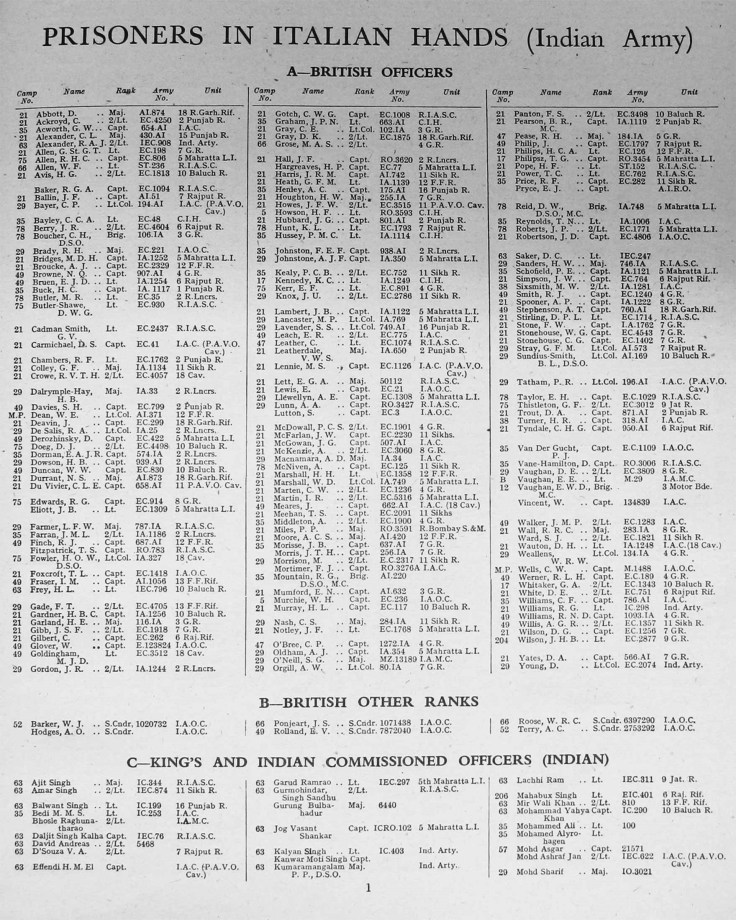
| CAMP No. | TOWN | NAME | INITIALS | RANK | ARMY No. |
| 21 | CHIETI | Colley | G.F. | Maj. | IA. 1134 |
| 21 | CHIETI | Harris | J.R.M. | Capt. | AI. 742 |
| 35 | PADULA | Kealy | P.C.B. | 2/Lt. | EC. 752 |
| 29 | VEANO | Knox | J.U. | 2/Lt. | EC. 2786 |
| 21 | CHIETI | McFarlan | J.W. | Capt. | EC. 2230 |
| 78 | SULMONA | McNiven | A. | Capt. | EC. 125 |
| 21 | CHIETI | Meehan | T.S. | Capt. | EC. 2091 |
| 29 | VEANO | Morrison | M. | 2/Lt. | EC. 2317 |
| 29 | VEANO | Nash | C.S. | Maj. | 284. IA |
| 35 | PADULA | Price | R.F. | Capt. | EC. 282 |
| Ward | S.J. | 2/Lt. | EC. 1821 | ||
| 49 | FONTANELLATO | Willis | A.G.R. | 2/Lt. | EC. 1357 |
1st February 1942 at The Fall of Benghazi
With “B” echelon, the Battalion had lost….“ (the following)
| CAMP No. | NAME | INITIALS | RANK | ARMY No. |
| 35 | Kealy | P.C.B. | 2/Lt. | EC. 752 |
| 29 | Nash | C.S. | Maj. | 284. IA |
| 35 | Price | R.F. | Capt. | EC. 282 |
| 49 | Willis | A.G.R. | 2/Lt. | EC. 1357 |
“Of the missing, confirmation of their safety was later received – except for Willis, who, after covering 250 miles on foot, made his way to the XXXth Corps headquarters at Gazala.“
My Dad had walked from Benghazi to Gazala! I’m guessing he wasn’t able to follow that up 5 months later!
WWW2Talk
Andreas – Post No. 83
4/11 Sikhs were a part of 7 Indian Infantry Brigade, 4 Indian Division in 1941/42.
They left that Brigade in April 1942.
In November 1941 they were involved in the famous stand of 7 Indian Bde at Sidi Omar, where the gunners of 1 Fd Rgt ripped apart what remained of Panzerregiment 5. The gunners and 4/11 Sikh were coverng Pt. 203.
On 13 December they attacked at the Gazala line, near Alam Hamza.
On 18 December they were at Derna, where they shot up 7-8 Ju 52 transport planes that had landed in front of their eyes, not knowing that the airfield had been overrun by the enemy, and captured over 200 POW when A Coy ambushed a retreating Italian column. They then participated in the pursuit to Agedabia.
In January 1942 were cut off in Agedabia, and broke out into the desert to escape the encirclement by Axis troops.
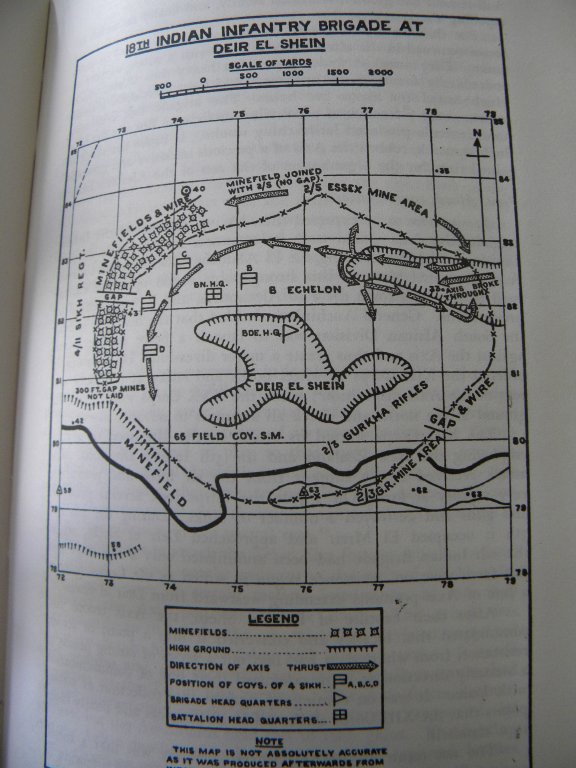
1st July 1942 at the Battle of Deir el Shein

2nd July 1942 (the day after the Battle of Deir el Shein)
It looks like only the following were NOT captured at Deir el Shein:
- Bampfield, Richard – Lt-Col.2
- Trestrail, S.A.C. – T/Capt.3 (The Adjutant (?) escaped Battle of Gazala June 1942 and Deir el Shein 1st July 1942
but later killed in Italy 1945) - Wimbush, A.C.B. – 2/Lt.
7th July 1942 (Diary entry)
“Our losses in the DEIR EL SHEIN Box were BO 7, VCO’s, IOR’s 500, Foll’s 32.”
Could the BO 7 be the following 7 British Indian Army Officers of the 4/11th Sikh Regiment?:
- Colley
- Harris
- McNiven
- Knox
- Morrison
- Ward
- Willis
davidbfpo – Post No. 98
- Purves, James Jarvie, Lieutenant Colonel (D.S.O.) … (see above pdf)
‘Lt-Col. Purves commanded the 4/11 Sikh Regt. throughout the operations from November 16th 1941 up to the occupation of Bengazi by our forces in January 1942. Outside Sidi Omar his battalion, which was giving local protection to the 1st Field Regiment R.A. was subjected to a heavy tank attack but stood firm while the guns beat off the attack. Again South West of Gazala his battalion was moving to attack in lorries when the German Panzer Div. launched a counter attack. When ordered to fall back behind the line of A.Tk. defence, Col. Purves cooly turned his battalion about and withdrew them in perfect order. His battalion was largely responsible for the capture of Derna aerodrome, the destruction of several enemy aeroplanes and subsequently the fall of Derna itself. Throughout the period of these operations this officer has set a high standard of personal example and bravery worthy of the highest traditions’. Signed by Neil Ritchie – Lt.-Gen. G.O.C.-in-C. Eighth Army. ↩︎ - Bampfield, Richard (13th August 1898 – 11th August 1964) was an English first-class cricketer and an officer in the British Indian Army. Bampfield was born at Frome in August 1898. He was educated at St Edward’s School, Oxford. From there, he went to British India to attend the Wellington Cadet College (1915-1920) based in Tamil Nadu in India, graduating from there into the British Indian Army as a Second Lieutenant in June 1917, with him seeing action in the final fifteen months of the First World War. By December 1919, he held the rank of Lieutenant and acted in the capacity of an aide-de-camp until February 1920.
Promotion to Captain would follow, with a further promotion to Major coming in June 1935. Bampfield was a member of the 11th Sikh Regiment and spent time as an instructor at the Indian Military Academy at Dehradun beginning in July 1937. Bampfield would serve with the 11th Sikh in the Second World War, seeing action in the Middle East campaign for which he was mentioned in despatches in December 1941. He was promoted to Lieutenant-Colonel during the war in June 1943. He retired from active service in September 1948, three years after the end of the war and a year after Indian Independence; the latter event had seen him transferred to the specialist list of the British Army. Bampfield died at Rustington on 11th August 1964, two days before his 66th birthday. ↩︎ - Lieutenant, Trestrail, Simon Anthony Cunningham – 4th Battalion, 11th Sikh Regiment.
“As an officer in the 11th Sikh Regiment, Simon saw service in the Sudan, the Western Desert and Italy. He was wounded in 1941, was twice mentioned in despatches and in 1942 was awarded the Military Cross for, in the words of the recommendation for award, his ‘coolness under heavy shell fire’ and his ‘fortitude and bearing’ in action at the Battle of Gazala. Surrounded by enemy troops, with many of his battalion captured, he lay low for three hours, and under cover of darkness he escaped beyond the Germans’ perimeter wire and after a mile came across an abandoned Matilda tank with the engine running! He drove this to the British lines and duly handed it over to 4th Armoured Brigade.”
Died 16th May 1945 – Aged 27 years. CWGC – Coriano Ridge War Cemetery. ↩︎ - Bampfield, Richard (13th August 1898 – 11th August 1964) was an English first-class cricketer and an officer in the British Indian Army. Bampfield was born at Frome in August 1898. He was educated at St Edward’s School, Oxford. From there, he went to British India to attend the Wellington Cadet College (1915-1920) based in Tamil Nadu in India, graduating from there into the British Indian Army as a Second Lieutenant in June 1917, with him seeing action in the final fifteen months of the First World War. By December 1919, he held the rank of Lieutenant and acted in the capacity of an aide-de-camp until February 1920.
Promotion to Captain would follow, with a further promotion to Major coming in June 1935. Bampfield was a member of the 11th Sikh Regiment and spent time as an instructor at the Indian Military Academy at Dehradun beginning in July 1937. Bampfield would serve with the 11th Sikh in the Second World War, seeing action in the Middle East campaign for which he was mentioned in despatches in December 1941. He was promoted to Lieutenant-Colonel during the war in June 1943. He retired from active service in September 1948, three years after the end of the war and a year after Indian Independence; the latter event had seen him transferred to the specialist list of the British Army. Bampfield died at Rustington on 11th August 1964, two days before his 66th birthday. ↩︎ - Lieutenant, Trestrail, Simon Anthony Cunningham – 4th Battalion, 11th Sikh Regiment.
“As an officer in the 11th Sikh Regiment, Simon saw service in the Sudan, the Western Desert and Italy. He was wounded in 1941, was twice mentioned in despatches and in 1942 was awarded the Military Cross for, in the words of the recommendation for award, his ‘coolness under heavy shell fire’ and his ‘fortitude and bearing’ in action at the Battle of Gazala. Surrounded by enemy troops, with many of his battalion captured, he lay low for three hours, and under cover of darkness he escaped beyond the Germans’ perimeter wire and after a mile came across an abandoned Matilda tank with the engine running! He drove this to the British lines and duly handed it over to 4th Armoured Brigade.”
Died 16th May 1945 – Aged 27 years. CWGC – Coriano Ridge War Cemetery. ↩︎
A Final (?) postscript to the 4/11th Sikh Regiment I’ve come across (thanks to David Ryan on WW2Talk) is a War Diary of 4-11 Sikh Regiment for the month of November in 1945 as the Regiment was undertaking preparations for returning to India at the culmination of World War 2:-
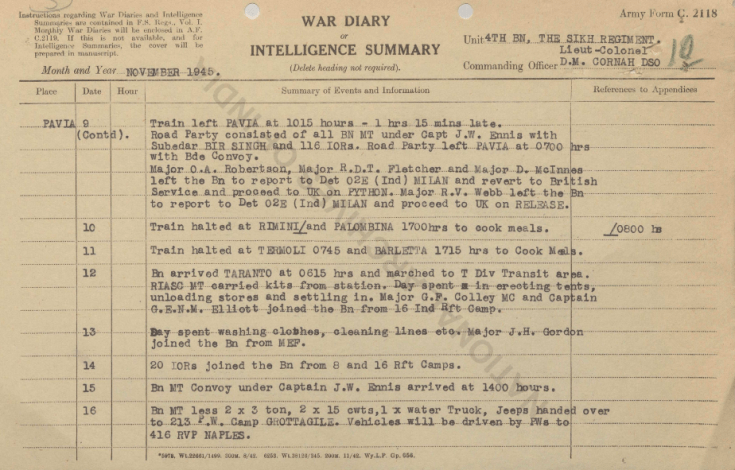
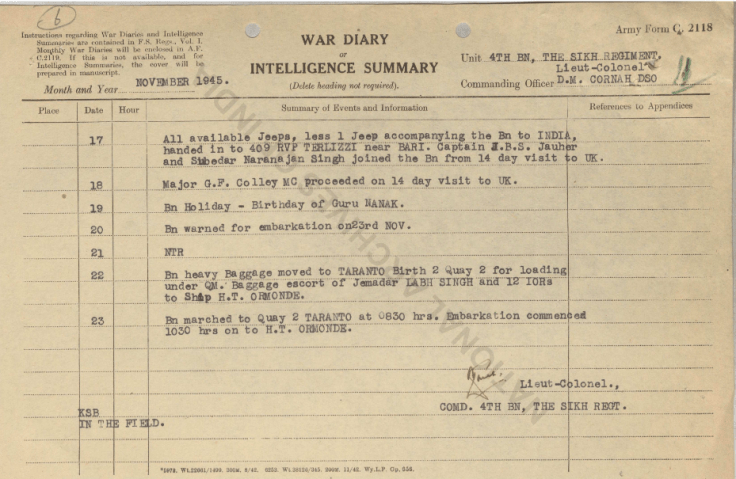
Based at Pavia near Milan on 9th November 1945 the Regiment proceeded to travel south by Train and Motor Transport (M.T.) through Rimini, Palombina, Termoli and Barletta finally arriving at the southern Port of Taranto to board “H.T. ORMONDE”
A list of British Officers mentioned in this Diary during November 1945:
- Lieut. Colonel D.M. Cornah D.S.O. – COMD. 4TH BN, THE SIKH REGT.
- Major G.F. Colley M.C. (joined Btn. 12th Nov from 16 Ind. Rft. Camp and left for U.K. on 18th Nov for 14 day leave)
- Captain G.E.N.M. Elliott (joined Btn. 12th Nov from 16 Ind. Rft. Camp)
- Capt. J.W. Ennis (Road Party with Subedar BIR SINGH)
- Major O.A. Robertson (to U.K. on PYTHON)
- Major R.D.T. Fletcher (to U.K. on PYTHON)
- Major D. McInnes (to U.K. on PYTHON)
- Major R.V. Webb (to U.K. on RELEASE)
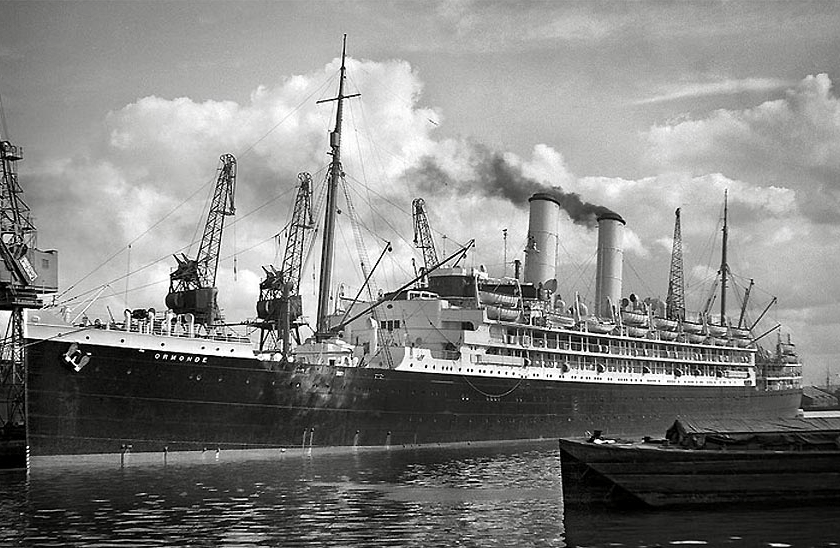
Photograph by & © John Currin
“In November 1942 the H.M.T. Ormonde landed troops in Algiers, Oran and Bone during “Operation Torch, and in July 1943 there were landings of troops in Sicily. The H.M.T. Ormonde continued her services with great efficiency! Next in 1945 the H.M.T. Ormonde landed troops in Malaya and then she continued to repatriate prisoners-of-war from Burma.”
 PG 49 at Fontanellato in Italy - The Story of allied servicemen who were held prisoner of war in this town in Italy in World War II