Lieutenant-Colonel Richard (Dick) Wheeler provided the Monte San Martino Trust with invaluable information regarding the events that took place at P.G. 49 in Fontanellato in the summer of 1943, following enquiries and investigations carried out by the son of Lieutenant Colonel Hugo De Burgh which led to the production of their Archive Report.
Richard’s own report on his period of stay at P.G. 49 in Fontanellato read as follows:-
1. Preliminary. I was sent to 49 POW Camp, Italy in May 1943. The camp had been open for a short time only. It held, roughly, 450 officers and 100 O.R. [Other Ranks] collected together, during May, from many camps, but particularly from small camps which the Italians had closed to economise in guards and to avoid risk of being over-run by the Allied forces.
The camp, therefore, was a collection of lesser camps, each with its own individuality. Discipline had evidently been lax in some of these camps. Esprit de corps was lacking. Turn-out and morale of many of the POW’s was bad.
Lieutenant-Colonel de Burgh arrived a short time later. He was the Senior Officer in the camp.
2. Reason for this report. I was the “Intelligence” officer in the camp and therefore in close touch with a very large number of the officers and O.R.’s [Other Ranks]. I was able to observe, personally, the great effect of Lieutenant-Colonel de Burgh’s leadership on the morale of the camp. I am certain that the successful evacuation of the camp was due to his work. I have noticed that no record has been made of his work and I wish to repair that omission.
3. Details of Lieutenant-Colonel de Burgh’s work before the fall of Italy.
(a) By his personal example of firm, dignified and determined behaviour to the Italians, Lieutenant-Colonel de Burgh set the standard for the attitude of the British to the Italians, and insisted on, and achieved, proper and respectful treatment of the British by the Italians. He checked all irresponsible “baiting” of Italians and insisted on courteous and correct treatment. He thus won the confidence of the Italian officers and O.R.’s [Other Ranks] and made it easy to handle them to British advantage when the crisis arose.
(b) By his force of character and personality Lieutenant-Colonel de Burgh welded the camp into a disciplined body, divided into homogenous companies, properly officered. Turn-out was excellent, for example the whole camp dressed for dinner. Steadiness and smartness on roll-call parade was remarkable. This was achieved without sanctions, by a carefully graduated programme which demanded an ever-higher standard, and which depended for it’s fulfilment on Lieutenant-Colonel de Burgh’s personal authority.
(c) The organisation of the camp into COY’s [Company], with their own officers, was perfected with the purpose of preparing for evacuation of the camp when the chance came.
(d) Generally Lieutenant-Colonel de Burgh revived morale in the camp, instilled esprit de corps and determination and prepared all POWs for the coming test.
He was a true leader, achieving authority under difficult conditions, and upholding the prestige of the British.
4. Detail of Lieutenant-Colonel de Burgh’s work at the fall of Italy.
(a) He was in close touch with the Italian Command throughout.
(b) He kept a firm hold of the POW’s, organising the whole camp for instant evacuation but allowing no irresponsible movement.
(c) At the critical moment he evacuated the camp to the neighbouring woods, taking all essential records. So short was the time available that the Germans entered the camp 15 minutes later to find the lunch of the table.
Here I should like to call attention, once more, to the fine work done by Italian Commandant, Colonel Vice-Domini, who allowed the camp to be evacuated and remained, himself, to face the Germans. He was arrested and taken to Germany. The Interpreter, Captain Camino and Lieutenant Peredini also did fine work, reported on elsewhere. Under Lieutenant-Colonel de Burgh’s leadership there was no straggling or panic haste.
(d) The camp was held, in its military organisation in the woods for two days whilst civilian clothing and food were procured and various plans for further movement were made. Lieutenant-Colonel de Burgh was in very bad shape, physically, after a winter spent in bed with pneumonia and after 15 months malnutrition. I can testify, as one who was with him the whole of this time, that he never rested in his efforts to plan for the future movement of the camp. It became clear, however, that so large a body of officers and ORs [Other Ranks] could not hold together in a country terrorised by Fascists and Germans. Lieutenant-Colonel de Burgh therefore gave permission for individual action.
(e) He remained in the area for, roughly, a further week, until it was clear that no more could be done. He then set out for Switzerland, which he reached, roughly, a week later.
In a report submitted by a Giuseppe Sambataro included in the papers gathered in the Post assembled for Hugo De Burgh details were provided of the start of their journies to Switzerland:-

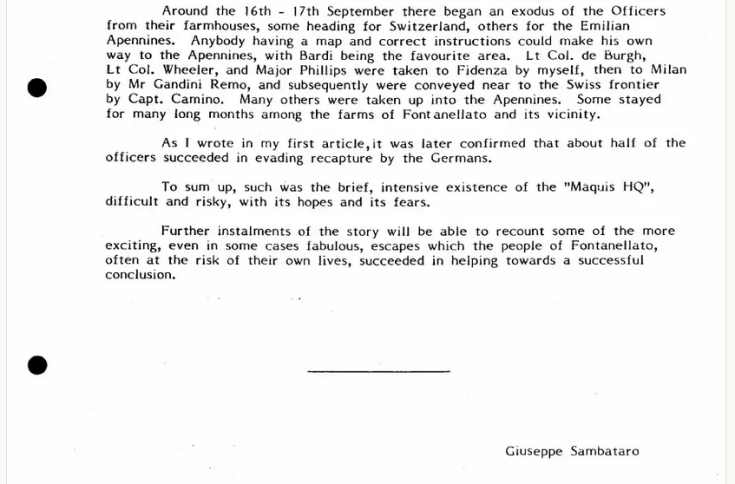
Around the 16th – 17th September there began an exodus of the Officers from their farmhouses, some heading for Switzerland, others for the Emilian Apennines. Anybody having a map and correct instructions could make his own way to the Apennines, with Bardi being the favourite area. Lieutenant-Colonel de Burgh, Lieutenant-Colonel Wheeler, and Major Phillips were taken to Fidenza by myself, then to Milan by Mr Gandini Remo, and subsequently were conveyed near to the Swiss frontier by Captain Camino. Many others were taken up into the Apennines. Some stayed for many long months among the farms of Fontanellato and its vicinity.
Hugo De Burgh later reported in his own analysis of these events that “by now Germans and Fascists were searching for escaped prisoners and all movement in north Italy was being watched, so we were gradually forced up one of these valleys towards the mountains. We began to fear that a party of three was too conspicuous, so Dick Wheeler went off on his own. He eventually succeeded in negotiating one of the passes alone and arrived in Switzerland.“
 PG 49 at Fontanellato in Italy - The Story of allied servicemen who were held prisoner of war in this town in Italy in World War II