From the National Army Museum –
Brigadier Richard Carver, CBE, DSO, MC, 1945
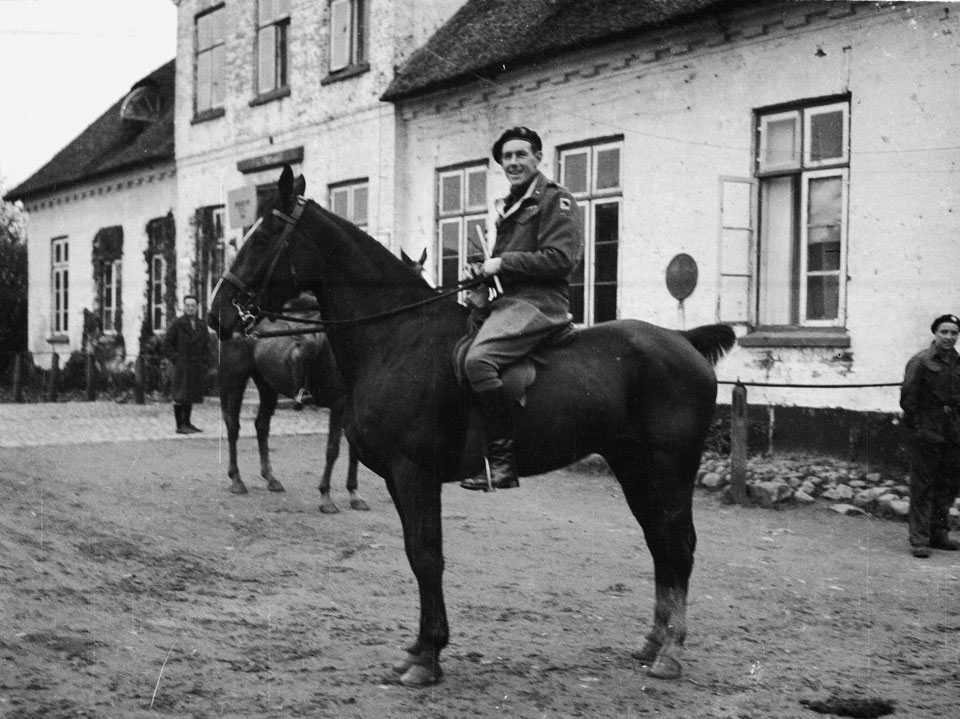
Carver had fought in the North Africa campaign from 1941, winning an MC during the bitter struggle for Tobruk. A substantive captain, he was made temporary acting Lieutenant-Colonel at the age of 27, on taking up a brief posting as GS01 (senior staff officer) of the 7th Armoured Division in 1942. As commanding officer of the 1st Royal Tank Regiment from April 1943, Carver won his first DSO, leading a dangerous reconnaissance before the decisive battle of El Alamein.
The second DSO followed the Allied landing at Salerno, after which he played a leading part in the capture of Naples. He also led his regiment into Normandy in June 1944. Shortly afterwards, at the age of 29, he became the army’s youngest brigadier when he was given the command of 4th Armoured Brigade. Carver was awarded a CBE in 1945.
“The below account of Richard’s life is a combination of research from The Times Obituaries, the Daily Mail, MilfordonSea.com and online interviews with Tom Carver.
A full account of Richard’s life and war exploits are also available in a book called ‘Where the hell have you been?’, which is written by Richard’s son, Tom Carver, who is a writer and former BBC foreign correspondent. The book is published by Short Books.
Colonel Richard Carver OBE RE, also known as Dick Carver, was born on 26th May 1914. He lived in Milford on Sea for 28 years of his later life and died in the village on the 24th July 2007 at the age of 93. A Service of Thanksgiving was held for him at All Saints’ Church on Friday 17th August 2007.
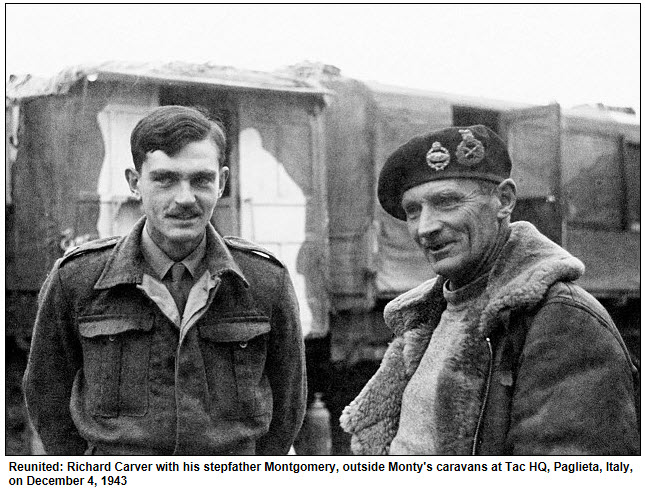
Richard was a stepson of Field Marshal Viscount Montgomery of Alamein. After reading engineering at Trinity Hall, Cambridge, he was influenced by Montgomery to apply for a commission in the Royal Engineers in 1936.
When Montgomery was appointed to command the 8th Army (Commonly known as The Desert Rats) in the Western Desert in 1942, Richard joined him as one of his forward liaison officers at HQ.
After the breakthrough of Rommel’s WWII positions was finally achieved at El Alamein in November 1942, Montgomery sent Major Richard Carver forward to reconnoitre a new location for his tactical HQ. On a desert track believed to be within the British forward area, he drove into a German patrol and was taken to Rommel’s HQ. Although interrogated, his name prevented discovery of his relationship with Rommel’s arch opponent.
As prisoner of war for 14 months he was sent to Italy, where he was moved from camp to camp until finally held at Fontanellato, near Parma.
When Italy surrendered in July 1943, after warning the prisoners that the Germans would arrive in a few hours to take over, the Italian commandant, Eugenio Vicedomini opened the gates and told them they were free to go. Many of the ex-POW’s decided to put distance between them and the camp, but Carver stayed nearby, reasoning that the Germans would concentrate their search further afield. He and some 600 others hid in an overgrown drainage ditch three kilometres away and, for two days and nights, listened to search parties driving by.
Once the search slackened, Richard Carver and several companions headed south to meet the 8th Army advancing up the Italian peninsula. They walked by night and hid in barns or woodland by day. The Italian farmers were usually glad to share with them what food they had and, on one occasion, he was given meat wrapped in a poster warning Italians that the penalty for harbouring PoWs was execution.
One morning, near Gessopalena, in the Abruzzo region of central Italy, a boy stumbled across the two men hiding in some bushes. Some Germans had stolen his pet pig and the boy planned to try to snatch it back, but the pig was forgotten when he saw Carver and his companion. For six weeks the boy’s family, the de Gregorios, looked after the two ex-prisoners, Richard and South African infantry officer Jim Gill, by then they were malnourished and suffering from dysentery. If a German patrol approached, a neighbour across the valley would hang a sheet from the window and the pair would be hustled into a nearby cave.
In December 1943 the two crawled across the shattered tracks of a railway bridge over the River Sangro to reach the Allied lines near Paglieta in the Abruzzo region of Italy. Despite his withered leg, Carver had walked more than 500 miles. Montgomery was delighted to discover that his stepson was alive, having not seen him for more than a year. When reunited with his stepfather, with whom he had been serving as a liaison officer, the great man simply asked: “Where the hell have you been?”.
After recuperating in the UK, Carver took part in the Normandy landings and was wounded in the leg during a mortar attack outside Caen, but recovered in time to take part in the advance across Germany and the liberation of several concentration camps, including Belsen. He posted up cuttings from British newspapers in German villages through which he passed showing pictures of these camps, but the locals dismissed them as propaganda. He was mentioned in dispatches for his wartime service.
In 1958 he was awarded an OBE for work at the Ministry of Defence and promoted colonel to take command of the Christmas Island base where Britain’s first H-bombs were being dropped, but with a nuclear testing moratorium approaching, tests were suspended after September. After leaving the Army in 1966, he taught mathematics at Marlborough and Radley for a while. When the MoD invited him to write Royal Engineer manuals, he accepted with delight and continued until his final retirement to Milford on Sea in 1979.”
 PG 49 at Fontanellato in Italy - The Story of allied servicemen who were held prisoner of war in this town in Italy in World War II