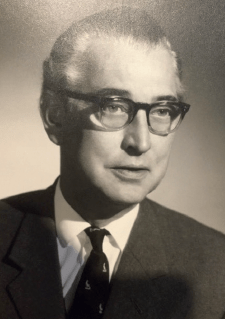
“Mike Goldingham (18 Cavalry, Indian Army) was imprisoned in PG49 Fontanellato, having also been in Bari and Chieti. Goldingham established a reputation as the camp forger and it is easy to imagine his expertise in that ‘profession’ since this contemporaneous diary includes many wonderful sketches of people and places he encountered during the war. After the Armistice, he made his way South, staying for 6 weeks with a family at Villora near Bardi, but unfortunately he was recaptured in sight of the allied lines near Pescara. He ended the war in the camp at Brunswick in Germany. His story includes an obituary and anecdotes written later.” – M.S.M.T. Archives
Mike the Forger


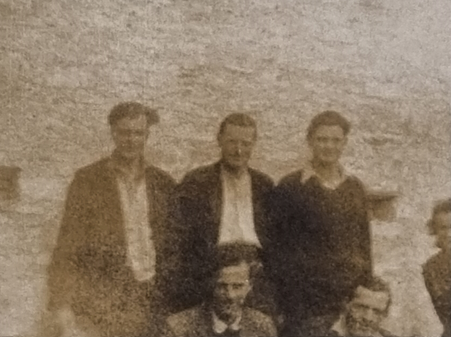

If indeed these are Ballantyne, Goldingham, Houghton and Lewis-Heath, then which of these men above is Mike?
“ON 27th May 1942, as part of the 3rd Indian Motor Brigade, Mike, as he was known, was captured by the Germans just south of Tobruk. After transit camps he was flown from Benghazi to Italy. Having spent two months in Bari, he was moved to PG21 at Chieti, and in April 1943 to Fontanellato, near Parma.
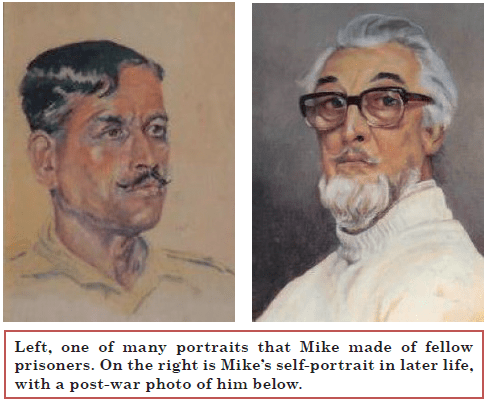
Mike considered PG49 the luxury camp of Italy, apart from the Generals’ camp near Florence. It had spring beds, mattresses, furniture, a bar – vermouth and sometimes beer in the morning, vino in the evening – a black market, sizeable sports field and a good commandant. However, escape, was uppermost in the prisoners’ minds. Although Mike did not talk about his experiences until later in life, he kept a wartime log recording camp experiences, his escape, and the people he met. Most pages included a small watercolour drawing. He painted many of his fellow prisoners and, while on the run, the contadini. Mike who was born in Great Missenden, Bucks, had strong family links with India and his talent for drawing owed something to one of his forbears, Captain George Andrew Goldingham (1835-1919), a highly regarded portrait painter in India. Mike enjoyed sketching during lulls in the fighting although art materials were hard to come by. As he had no watercolour with which to shade his drawings he developed a technique of ink stippling. Escape organisations had people who could make uniforms and civilian clothing, reproduce maps and many things but they lacked a camp forger. Mike spent most days sitting on his bed turning out false documents, Gestapo passes, banknotes, fake tickets, bread coupons, official letterheads and other items necessary to facilitate movement under wartime restrictions. He always had near him a half-finished painting or stipple drawing as cover in case of a raid on a dormitory.
Months passed at Fontanellato without him being detected. Then a cache of his forgeries was found by a search party. The fakes were linked to similar material found in the possession of several escapee British officers and production was traced to Mike. Shortly after this, on 8th September 1943, the Armistice was signed, the commandant opened the camp gates and the PoWs escaped.
Mike and three Indian Army friends – John Meares, Paddy Bruen and Andre Willis – headed for the hills above La Spezia and Genoa in case the Allies should land there. They ended up in a village called Villora, near Bardi, where Mike and John Meares were adopted by Marco Labadini, the village toper, who ran a smallholding with his wife Maria. Marco refused to go to church on Sundays, and used to lock them in his cellar with bread and cheese and force wine onto them until well after the services had ended. During the day they helped in the fields.
On October 27th they moved south in an attempt to reach the Allies, with the help of a small map. The distance to the front line near the River Sangro was 480 miles although they must have walked about 900 miles to get around the tricky bits and over the mountains. On December 15th, on the snow line and within hearing of the guns, they were captured by a German patrol on skis. They spent the rest of the war at Marich-Trubau in Sudetenland and then at Oflag 79 at Braunschweig in Germany, where Mike again worked as forger. After the war, Mike worked for an insurance firm, travelling widely. He died in Perth, Australia, aged 80. Looking back, he realised how much he owed to the contadini, and after the war he revisited Villora. My brother Miles also visited Villora in 2003 and met Marco’s son.
As for his art, Mike commented wryly: “Perhaps the highlight of all this was the ‘compliment’ paid me by the Italians. They staged an exhibition of my forgeries in Rome. It would have been fun to have heard the comments about the ‘wicked British prisoners’”
Patrick Goldingham writes about his father, Lt. Michael John Dalrymple Goldingham, MC, of the 18th King Edward V11’s Own Cavalry. A talented artist, Mike worked as a forger on behalf of escape committees at the camps where he was imprisoned.
Source: Monte San Martino Trust Newsletter of June 2018 p.3 – see Newsletters
 PG 49 at Fontanellato in Italy - The Story of allied servicemen who were held prisoner of war in this town in Italy in World War II