One of the great things about creating this website is that every now and then I’m contacted by someone who has come across the name of a relative who I have named in the Roll Call. Whether it be an Allied Soldier who had been taken Prisoner of War and had been in P.G. 49 at Fontanellato at the time of the Italian Armistice in September 1943. Or perhaps a relative of an Italian family who had assisted one of these men as they were making their way through Nazi occupied Italy after their release.
And so it was that I received this message from the son of Lieutenant F.P. Jordan in April 2025:-
“My father Ltn F P Jordan 220630 was a POW in PG49 Fontanelto (sic.) from March ’43 to the Sept. At the time of capture at Bir Hasheim in the early stages of the Battle of Gazala he was commander of Troop Nr 1, X Squadron, 50th Btn Recon Corps. He told me how he was captured as a member of LRDG, his time at PG49 (he was transferred there from PG47 Modena) as one of the first before it officially opened. I have a photo of him later at OFLAG79 where he was a member of the Brunswick Prison Camp Printers with your father. I believe he may have met your father earlier in his time as a POW and was also in OFLAG VIIIF with him. Some names keep cropping up including A Cubbin, W Pringle, John Verney, D Stirling, K Crofton, E Newby and several others. I am currently writing a book on his time as a POW. He was recaptured after the Mass Breakout after 6 weeks near Sulmona “within sounds of Allied Artillery”. I have a lot more info if you are interested.“
Well of course I’m interested aren’t I. It seems this guy knew my Dad! How fantastic! So I replied:-
“Hi Richard – How fantastic to hear from you, and yes I’d be delighted to hear more. It’s so great that you are writing a book about your father’s exploits and it sounds as though you have quite a bit of material to base it on. A few friends have suggested I do the same but at the moment I feel I have too many pieces of the jigsaw missing. Maybe one day if I’m lucky with unearthing more?
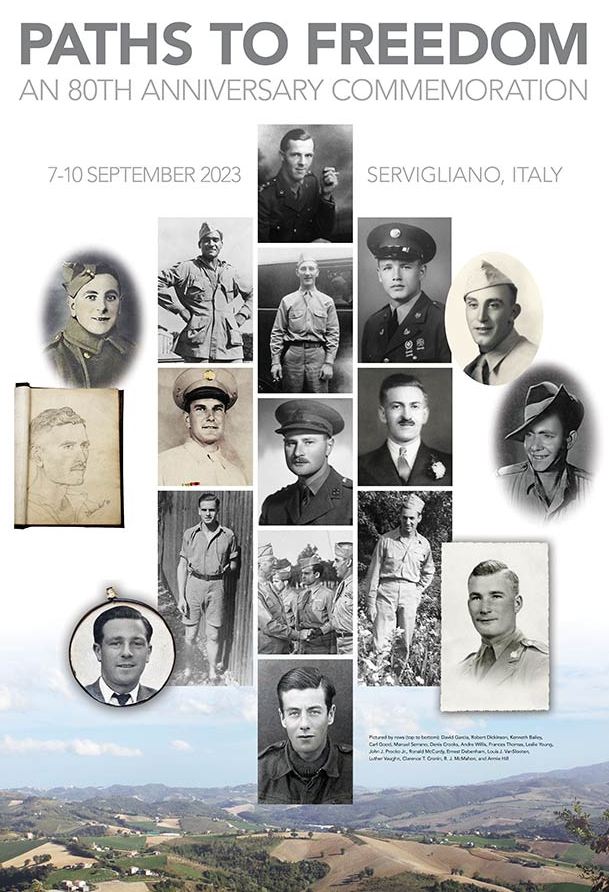
I’m so grateful for the assistance I’ve received from the Monte San Martino Trust which sparked my interest in this chapter of my Dad’s life and I’m really pleased that I have taken the steps so far with my website which, as you may have spotted, was inspired by the Camp 59 Survivors website created by Dennis Hill who I met in Servigliano in 2023 at the 80th Anniversary of the Armistice. Dennis included a picture of my Dad at the top of the poster he created for the event.”
“I’ve had a quick look through my “Roll Call” pages and was thrilled to see your Dad’s name there as well as Pringle and Crofton. I’ve not yet traced Cubin and Stirling although there seems to have been people added to the camp at various times, I think associated with Camps closing further south as the Allies advanced north. Eric Newby of course I do know about, in fact his books were some of the first I came across and were also responsible for inspiring my search. I’ve got an electronic copy of Keith Killby’s book “In Combat, Unarmed” and I’ve yet to purchase books by Nick Young “Escaping with his Life” about his father (who I know Dad bumped into after their release into the countryside) and recently Anne Copley has produced her book “The Girl with a Peach” of course and now I’ll have to add yours to my purchase list once it’s published 🙂.
I do hope that I can return to Fontanellato one day as the first time I went in 2019 I had only just started this journey and so it was only added as a lunch stop while driving from Lucca to Verona as our holiday itinerary had been set the year before and at that stage I had very little, if any, information about the camp. So you can imagine my surprise when I found out that it was a building still very much in use rather than the ramshackle Nissen huts I had been imagining!”
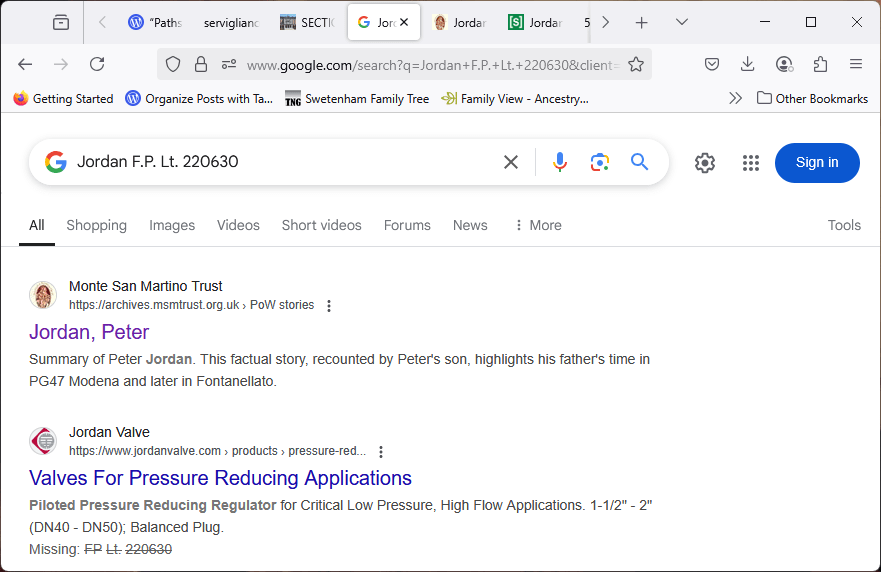
Richard very kindly responded by indicating that he was happy for me to add his Dad to my website, but then I decided to Google “Jordan F.P. Lt. 220630” to try and find out some detail that I could add and imagine my surprise when the top ‘find’ turned out to be on the Monte San Martino Trust site!
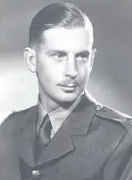
ARMY Service of Lieutenant F P Jordan (Peter)
Service Nr 220630
50th Btn Recon Corps (Northumberland Fusiliers)
Over the years, I have gleaned partial insights into my father’s war experiences. It started in my teens when, late at night, returning from his visit to the pub, he would recount episodes from his war. These reminiscences were, generally, garbled, often repeated and seldom conclusive. I do, however remember specific stories which I would later piece together with information from other sources. His most graphic memories were of his incarceration in a POW Camp in Italy between 1942 and 1943. In particular, he told of a grand building next to a convent with several floors; he remembers it as some sort of a hospital before the war and recounts tales of nuns (in Newby’s book these were local girls, not nuns) being whistled at and cheered by POWs as they, dressed in habits, walked in line past the camp. Several years later I read ‘Love and War in the Apennines’ by Eric Newby; I think I found it in my father’s possessions after he died in 1986. Many of the episodes in Eric’s book mirrored those late-night stories I remembered from my father.
But to begin at the beginning. Prior to the war, my father, a keen horseman, had joined the North Somerset Yeomanry, part of what became the Territorial Army, the TA. When war broke out, he was, I’m told, a Company Sgt Maj… allegedly the youngest in the then British Army. I remember him telling me that he was a Troop Sergeant with a horse called White Socks. At the age of 25 he was embarked with his troop to Aquir near Ramleh in Palestine. The NSY took over a former RAF Base and here he remained, apart from 2 weeks in mid-June ’41 where he was credited with the Syrian Campaign,(likely this was the Battle for Damascus where Indian, Australian and British troops supported the Free French in taking Damascus) until late 1941 when his Troop was disbanded (this is a guess… in fact the North Som Yeomanry was not disbanded until the following spring so whether he was sent to OCTU as part of the rationalization or because he was chosen for Officer Training is unclear. The base in Aquir was returned to the RAF in early ’42 at which time it became the home of Nr 2 Middle East Training Section under the command of WinCo Donald Benbow DFC who was to become my father’s brother in law. I have a memory that a mention was made somewhere that Donald had seen some mention of his OB friend on the base. They in fact had met in Cairo or Alexandria when Dad was at OCTU). He was then sent to OCTU in Egypt where he gained his Commission on 19th Oct ’41. In early Nov ’41 he served as 2nd Lieut, 50th btn, Reconnaissance Corp (part of the Long Range Desert Group made famous as the Desert Rats) back in Palestine. He was then posted to the Western Desert (Egypt) from 22nd Nov until 10th Jan ’42 before being sent back to Palestine and Syria until the end Feb ’42. He was then back in the Western Desert (Egypt) until his capture on 6th June ’42. This period relates to the British Army’s simultaneous defense of Palestine and Rommel’s attack on the western borders of Egypt in the Spring of ’42. In the June of that year, in the Battle of Gazala, the Germans, assisted by the Italians, attacked the southern flank of the Allies in the Cauldron, taking them by surprise and pushing the Allies back into Egypt. Dad was captured in this battle at Bir Hacheim as the commander of a Daimler Scout car. These vehicles had pre-select gears which drivers kept pre-selected in reverse, making a hasty retreat once the enemy was sighted by ‘dabbing’ the clutch. Whether this played a part in his capture is unclear. Dad told me that it was his senior officers under Major General Ritchie that were to blame for the fiasco that resulted in overrunning of the XIII Army including the 50th Btn by Rommel’s forces. This was also the conclusion of John Bierman and Colin Smith in their account pages 168 to 172 of Alamein, War Without Hate. It proved, however, to be the turning point of the war as it resulted in the replacement of General Auckinleck by Montgomery and the subsequent Battle of El Alamein.
He may have been held in holding camps prior to transport to Italy. After being shipped across the Mediterranean from North Africa to Italy during the late summer of ’42 he finally ended up in Oct ’42 in PG47, Modena where he was kept until April ’43. PG47 was a Field camp holding some 1000 prisoners, mostly South Africa airmen but some NZ and English Officers. Thereafter, the dates of his time as a POW are easier to reconcile. By March the following year PG47 held some 1248 prisoners, mostly South African, so some POWs, including Dad, were moved 80 kms west to PG 49, which had been opened in March ’43. PG 49 in Fontanellato, near Parma was a unique prison camp in that it was an imposing stone building in the town, built as an orphanage in the early ‘30s and put to use as a Prisoner of War camp housing some 600 inmates. It was from this camp in April that Dad was able to send a postcard to his sister Mary’s husband, Alan Scoones. By all accounts, this was one of the better POW Camps and camp life is recounted in Eric Newby’s book ‘Love and War in the Apennines’. Several of the episodes in that book tallied with stories told by my father in late evenings in the ‘60s, including the guards shooting at the POWs as they gathered at the windows to whistle at the local girls walking up the street past the orphanage and the breaking of Eric Newby’s ankle on the stairs just before the Mass Breakout. He escaped at the time of the Italian Armistice (9th Sept ’43) … the Italian Commander of the camp allowed the release of the prisoners the day before the arrival of the Germans, for which he paid dearly (see ‘Bugle Call to Freedom’ by Marco Minardi). In other camps, under instruction from the War Office, Senior Officers ordered men to ‘stay put and wait for the allied troops’ at this time stalled in the south. Some of the 600 escapees headed south in an attempt to join the Allies, among them William (Jack) Clarke. It is likely from his recollections that he followed much the same path as my father. Others, such as Eric Newby, joined local groups in the resistance and a few headed North to Switzerland. There are several accounts of these escapees and these are well documented. Many, including my father, headed south in small groups. Trying to cross difficult terrain in occupied territory must have been exceedingly difficult and many did not make it. Dad tells of living off chestnuts during this long hike of over 800 kms only to come up against the rear of the German Army holding the Allies at bay. He is reported as saying that he was within earshot of Allied guns when recaptured on the 26th October, some 6 weeks later, by German Paratroopers. By this time the Allies had landed at Salerno on September 3rd – 17th, although they were being fiercely contested by German Forces. He and many of the other Allied POWs were then sent to German Occupied territories in the north. This trip, in cattle trucks during the early winter, across the Alps must have been difficult and traumatic.
NOTE: I have an acquaintance here in Qala, whose sister Katty Kay, is married to Tom Carver, they are journalists. Tom’s father, Richard, was the stepson of Monty (see above) and was captured in Oct ’42 in the Western Desert before Rommel’s final defeat. He was sent to Italy and also landed up in PG 49 Fontanellato with Dad. At the time of the Armistice, he went South to try and link up with the allies. Unlike Dad he managed to get through the German lines and found his way to Monty’s HQ and his Stepfather who, on seeing him, apparently said, “And where the hell have you been!” Tom has recently written an account of his father’s exploits entitled: And Where the Hell Have You Been.
Initially my father, after recapture, was sent to Oflag V111F, a POW camp in Mahrisch-Trubau in Bohemia (now Moravska Trebova in east Czech Republic). I worked in Lanskroun not far away in the early 90s and know how harsh the winter can be! This camp housed around 2000 Officers, many originally captured in North Africa. In April 1944 these POWs were once again moved, this time to Oflag 79 in Brunswick, Northern Germany. His POW Nr was 1606 and I’m able to place him in that camp by the photograph of him in a group probably taken in the summer of ’44; the back of the photograph is stamped with OFLAG 7#. Photographs found on the web from Oflag 79 by Julia, my sister, are of groups of men, one of whom looks like my father and others that appear in the photograph in my possession. They are apparently a group who formed the Brunswick Prison Camp Printers and included Capt Michael Goldingham who was the Camp ‘Forger’ and as such not allowed to escape!
He recounted very little of the 18 months spent at Oflag 79 until the camp was taken by American Troops on 12th April 1945. He did recall, after release with a group of men, catching a pig and eating it. This was apparently fatal for some of the men, used to several years of poor diet and extreme conditions. Dad was repatriated before the Armistice on 5th May and subsequently demobbed from Catterick Camp in October 1945, a substantive Lieutenant.
 PG 49 at Fontanellato in Italy - The Story of allied servicemen who were held prisoner of war in this town in Italy in World War II