Also featuring – HEDLEY, Charlie
Having stumbled accross a Post on The Pegasus Archive entitled Anon while carrying out a Google Search, I was fortunate to discover the name of a soldier who had been in the same POW Camp (P.G. 49) as my father in 1943. A letter attached with the Post had provided the recipient of the letter (Maria and Family) with possible contact details for “Patrizio”, who appeared to be a Major P. De Clermont, and this then led to creating a couple of Posts of my own, namely:-
- ANON. plus DE CLERMONT, Patrick Howard Voltelin
- ANON. plus DE CLERMONT, Patrick Howard Voltelin (Part 2)
But who indeed was this Captain De Clermont? A couple of further Google searches led to the following:-
The latter had been mentioned in the Obituary for “Patrizio” and further information included a photograph as well as a full description of his life and career.

“Patrick Howard Voltelin de Clermont was born in 1912, a nephew of Brigadier Van der Byl who was Colonel of the 8th Hussars from 1930 to 1948.
Educated at Harrow and Sandhurst he was commissioned into the Regiment in 1932 when they were in Egypt.
Pat de Clermont was one of those ebullient characters who were almost larger than life, filling every ‘unforgiving minute’ with an enthusiastic vitality that often left his friends bemused.
He was a man of many parts but was first and last an 8th Hussar; from the moment he joined until the end of his life his devotion to the Regiment and his concern for the welfare of its members remained undiminished.“
But my investigations of the Allied Screening Commission documents being digitised by National Archives in Washington D.C. unearthed information for my 2nd Story, entitled NARA 2, which led to claims submitted by our man, together with a possible connection between the VAJENTI family, portrayed in the Anon story, and the name of Tina VAIENTA contained in this claim.

So what exactly is this claim and why has this individual taken it upon himself to submit it to the Allied Screening Commission? The first page sets the scene.
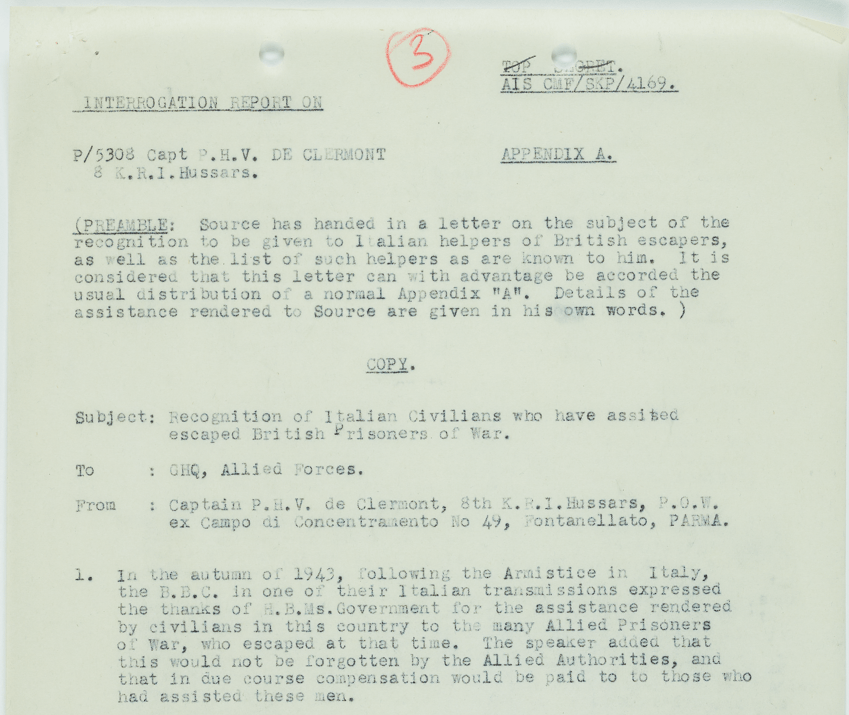
TOP SECRET
Record Group 331: Records of Allied Operational and Occupation Headquarters, World War IISeries: Subject Files Maintained by Lieutenant Colonel Hugo Graham De Burgh
AIS CMF/SKP/4169.
INTERROGATION REPORT ON
P/5308 Capt P.H.V. DE CLERMONT
8 K.R.I. Hussars.
APPENDIX A.
(PREAMBLE: Source has handed in a letter on the subject of the recognition to be given to Italian helpers of British escapers, as well as the list of such helpers as are known to him. It is considered that this letter can with advantage be accorded the usual distribution of a normal Appendix ¨A˝. Details of the assistance rendered to Source are given in his own words.)
COPY.
Subject: Recognition of Italian Civilians who have assisted escaped British Prisoners of War.
To: GHQ, Allied Forces
From: Captain P.H.V. de Clermont, 8th K.R.I. Hussars, P.O.W. ex Campo di Concentramento No 49, Fontanellato, PARMA
1. In the autumn of 1943, following the Armistice in Italy, the B.B.C. in one of their Italian transmissions expressed the thanks of H.B.Ms. Government for the assistance rendered by civilians in this country to the many Allied Prisoners of War, who escaped at that time. The speaker added that this would not be forgotten by the Allied Authorities, and that in due course compensation would be paid to those who had assisted these men.
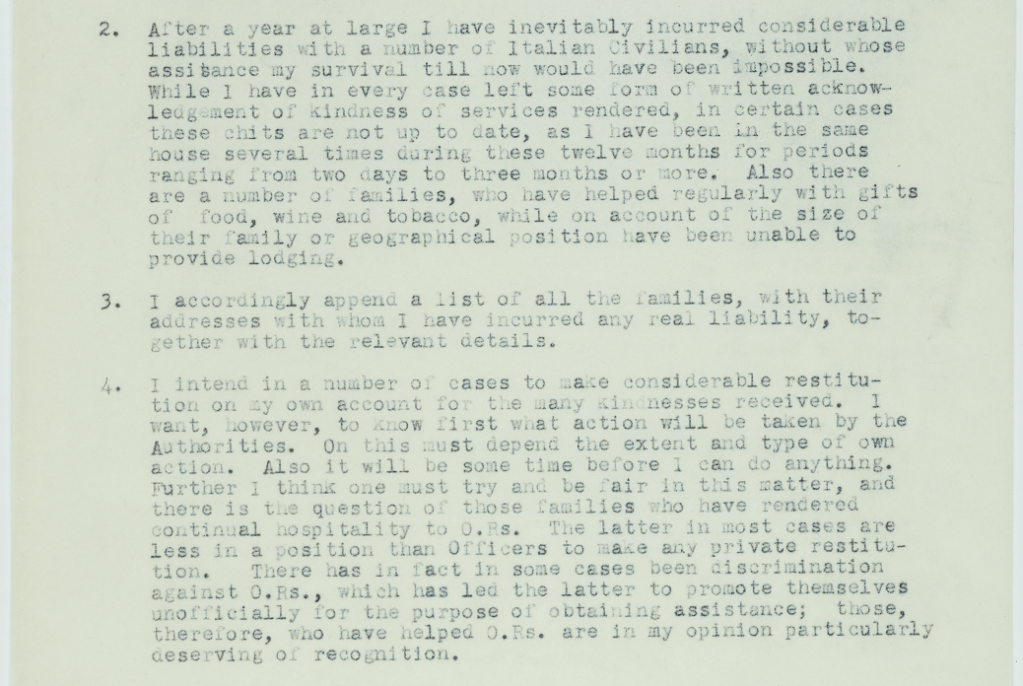
2. After a year at large I have inevitably incurred considerable liabilities with a number of Italian Civilians, without whose assistance my survival till now would have been impossible. While I have in every case left some form of written acknowledgement of kindness of services rendered, in certain cases these chits are not up to date, as I have been in the same house several times during these twelve months for periods ranging from two days to three months or more. Also there are a number of families, who have helped regularly with gifts of food, wine and tobacco, while on account of the size of their family or geographical position have been unable to provide lodging.
Citation – As Above
3. I Accordingly append a list of all the families, with their addresses with whom I have incurred any real liability, together with the relevant details.
4. I intend in a number of cases to make considerable restitution on my own account for the many kindnesses received. I want, however, to know first what action will be taken by the Authorities. On this must depend the extent and type of own action. Also it will be some time before I can do anything. Further I think one must try and be fair in this matter, and there is the question of those families who have rendered continual hospitality to O.Rs. The latter in most cases are less in a position than Officers to make any private restitution. There has in fact in some cases been discrimination against O.Rs., which has led the latter to promote themselves unofficially for the purpose of obtaining assistance; those, therefore, who have helped O. Rs. are in my opinion particularly deserving of recognition.
-2-
Citation – As Above
TOP SECRET.
App A to AIS CMF/SKP/4169.
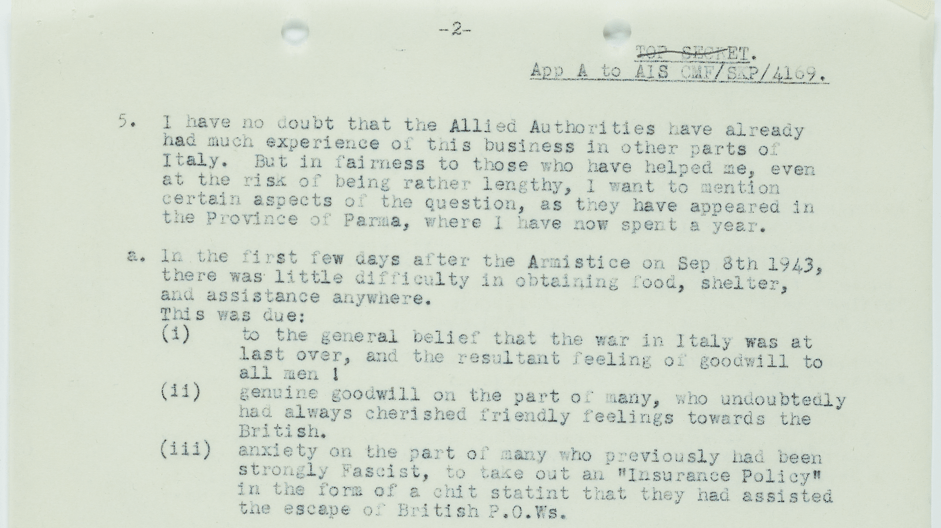
5. I have no doubt that the Allied Authorities have already had much experience of this business in other parts of Italy. But in fairness to those who have helped me, even at the risk of being rather lengthy, I want to mention certain aspects of the question, as they have appeared in the Province of Parma, where I have now spent a year.
a. In the first few days after the Armistice on Sep 8th 1943, there was little difficulty in obtaining food, shelter and assistance anywhere.
This was due:
to the general belief that the war in Italy was at last over, and the resultant feeling of goodwill to all men
genuine goodwill on the part of many, who undoubtedly had always cherished friendly feelings towards the British.
anxiety on the part of many who previously had been strongly Fascist, to take out an ¨Insurance Policy¨ in the form of a chit stating that they had assisted the escape of British P.O.Ws.
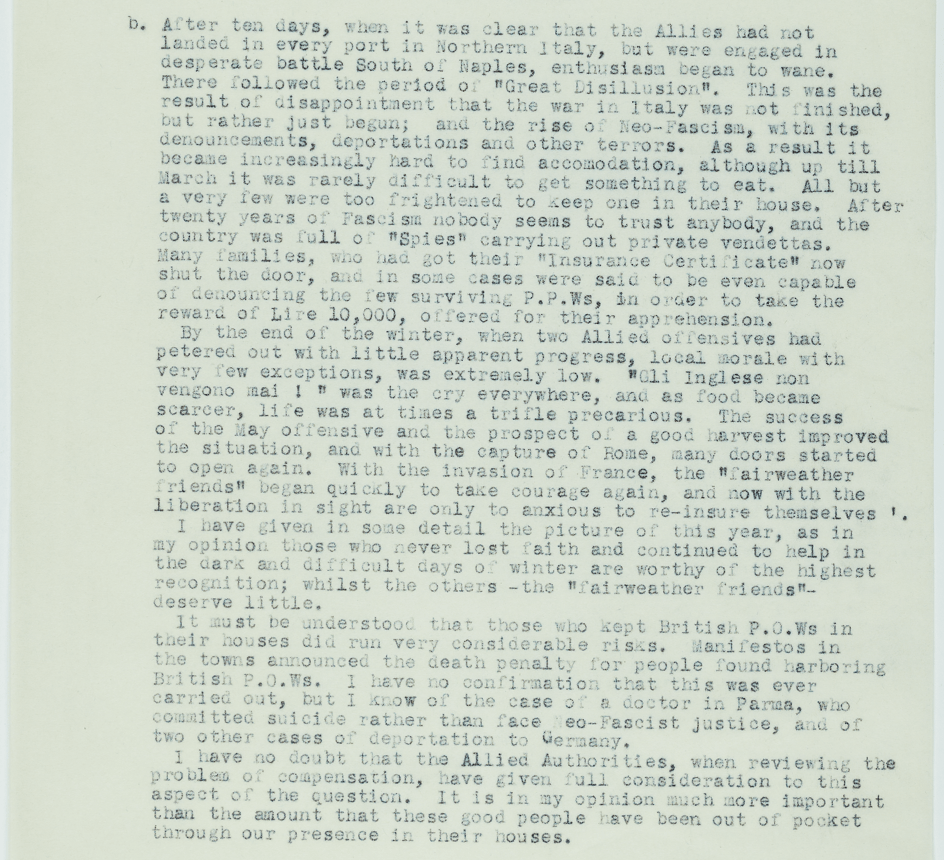
b. After ten days, when it was clear that the Allies had not landed in every port in Northern Italy, but were engaged in desperate battle South of Naples, enthusiasm began to wane. There followed the period of ¨Great Disillusion¨. This was the result of disappointment that the war in Italy was not finished but rather just begun; and the rise of Neo-Fascism, with its denouncements, deportations and other terrors. As a result it became increasingly hard to find accommodation, although up till March it was rarely difficult to get something eat. All but a very few were too frightened to keep one in their house. After twenty years of Fascism nobody seems to trust anybody, and the country was full of ¨Spies¨ carrying out private vendettas. Many families, who had got their ˝Insurance Certificate˝ now shut the door, and in some cases were said to be even capable of denouncing the few surviving P.P.Ws, in order to take the reward of Lire 10,000, offered for their apprehension. By the end of the winter, when two Allied offensives had petered out with little apparent progress, local morale with very few exceptions, was extremely low. ¨Gli Inglese non vengono mai!¨ was the cry everywhere, and as food became scarcer, life was at times a trifle precarious. The success of the May offensive and the prospect of a good harvest improved the situation, and with the capture of Rome, many doors started to open again. With the invasion of France, the ¨fairweather friends˝ began quickly to take courage again, and now with the liberation in sight are only to anxious to re-insure themselves. I have given in some details the picture of this year, as in my opinion those who never lost faith and continued to help in the dark and difficult days of winter are worthy of the highest recognition; whilst the others – the ˝fairweather friends˝ deserve little. It must be understood that those who kept British P.O.Ws in their houses did run very considerable risks. Manifestos in the towns announced the death penalty for people found harboring British P.O.Ws. I have no confirmation that this was ever carried out, but I know of the case of a doctor in Parma, who committed suicide rather than face Neo-Fascist justice, and of two other cases of deportation to Germany. I have no doubt that the Allied Authorities, when reviewing the problem of compensation, have given full consideration to this aspect of the question. It is in my opinion much more important than the amount that these good people have been out of pocket through our presence in their houses.
Citation – As Above

-3-
Citation – As Above
TOP SECRET
App to AIS CMF/SKP/4169.
6. Finally I would like to say a word regarding the type of compensation. At the present time money buys very little in this country, owing to the scarcity of goods. And what it does buy is third rate quiality. Further for the ˝Contadino˝, whose work is out of doors, certain things are vital, and now practically unobtainable at any price. This particularly applies in this province, where the majority of the people who have helped us are ˝Contadini˝. In the warm days of summer, they can carry on barefooted and halfnaked, but with the advent of winter they have need of boots and warm clothes. At the present time many are completely without boots, and on the ˝black market˝ must pay up to two thousand Lire for rubbish that wont stand one wet day on the land.
I wish to recommend most strongly that a part of any compensation be in the form of an option on a pair of G.S. boots, socks, clothes, etc.
Failing this I would request that I may be given authority to purchase these articles on Repayment ex Ordnance, so that I may give something, which is desperately needed, to these poor people, through whose kindness and courage I have been spared a year in P.O.W. camp in Germany.
8th Sept 1944
(Signed) P.H.V. de CLERMONT.
Captain.
8th H.R.I. Hussars
The above letter was written on Sep 8th, after it had been announced that the ¨Gothic Line¨ was broken, and there was reason to expect liberation within a few weeks. Owing to the changed circumstances, the last paragraph is therefore now redundant.
25/10/44.
(Signed) P.H.V. de CLERMONT
Capt. 8th H.
———————————————-
 PG 49 at Fontanellato in Italy - The Story of allied servicemen who were held prisoner of war in this town in Italy in World War II