The Allied Screening Commission, operating from 1944 to 1947 in Italy, aimed to identify and reward individuals who had helped Allied servicemen escape or evade capture. These helpers, primarily Italian civilians, were given certificates of thanks signed by Field Marshall H.R. Alexander and, in some cases, monetary rewards. The commission required helpers to provide their personal details, the names of Allied servicemen they aided, and the nature of the help offered.
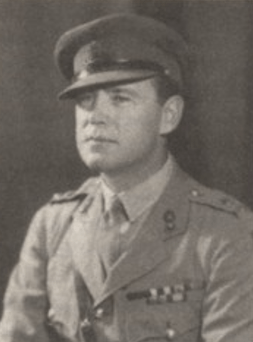
In 1946, Lieutent-Colonel Hugo Graham De Burgh (above), was in Italy as head of the Allied Screening Commission and his story “Switzerland Invaded“, as archived by the Monte San Martino Trust, provides an insight as to the depth of information he was able to bring to this role as a result of his personal experiences in escaping to Switzerland after the Italian Armistice in September 1943.
“The 1944-1947 Allied Screening Commission was tasked to track down Italian civilians who helped escapers and evaders. Helpers were given a certificate of thankfulness signed by Field Marshall H R Alexander, supreme Allied commander in the Mediterranean theatre, and – in some circumstances – cash. Helpers had to fill out a form in which they had to state their personal details, the names of Allied servicemen they helped and details on the nature of the help provided.”
- Purpose – The commission’s primary goal was to recognize and thank the individuals who had risked their lives to assist Allied soldiers, particularly those who had escaped from prisoner-of-war camps or evaded capture in occupied territories.
- Process – Helpers who came forward were required to complete a form detailing their assistance, including the names of the Allied servicemen they helped and the specific nature of the help provided (e.g., food, shelter, clothing, medical aid).
- Recognition – Those who assisted were awarded certificates of thanks, often signed by Field Marshall H.R. Alexander, the Supreme Allied Commander in the Mediterranean theatre. In some instances, they also received monetary rewards.
- Legacy – The commission’s work helped to establish a record of gratitude and recognition for the Italian civilians who had played a crucial role in aiding Allied servicemen during the war years.
- Record Keeping – The National Archives and Records Administration (NARA) holds records related to the Allied Screening Commission, including individual accounts of escapes and evades, recommendations for honors and awards, and questionnaires about escape routes and methods.
The Allied Screening Commission’s activities highlight the significant contributions made by civilians in Italy to the Allied war effort, demonstrating the widespread resistance and support for the Allied cause during the war.
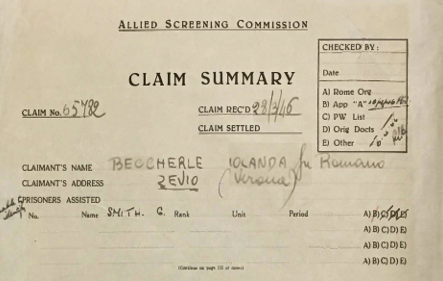
Above is a screenshot of the only “Claim Summary” I have seen thus far that is attributed to Iolanda Baccherle that I came across recently in a wonderfully evocative post submitted by Germana Canzi about her Great Aunt, entitled “My great aunt Iolanda, the unlikely Italian Resistance hero“.
See also – National Archives
 PG 49 at Fontanellato in Italy - The Story of allied servicemen who were held prisoner of war in this town in Italy in World War II