
The Article above was extracted from PARBATE (The Magazine for Gurkha Soldiers and their Families) Vol 74 No. 3: May/June 2022 (page 17). The 3rd Gurkha Rifles Scroll.
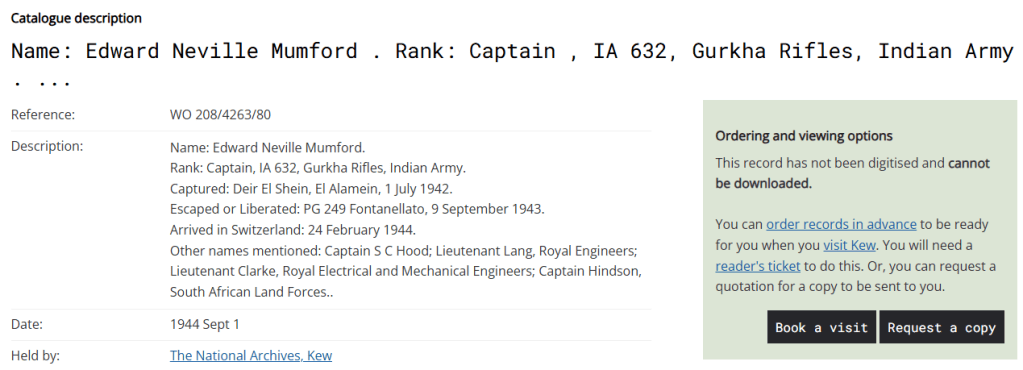
Edward Neville Mumford (E.N.M.) was established to be present at PG 49 Fontanellato at the time of the Italian Armistice on 8th September 1943.
June 1942 – British officer served as staff officer with Headquarters, 18th Indian Infantry Brigade1, 10th Indian Infantry Division in North Africa. Then Captain Edward Neville Mumford, 2/3 Gurkha Rifles (Queen Alexander’s Own), who was an Acting Major on the brigade staff.
July 1942 to September 1943 – Prisoner of War in Campo PG 21, Chieti and Camp PG 49 Fontanellato di Parma in Italy.
September 1943 to August 1944 – Escaped to Switzerland.
Taken prisoner, he walked out of prison camp, together with his Brigade C.O. Lieutenant Colonel C.E. Gray and others, including Captain Stuart Clink HOOD, and possibly Lieutenant Lang R.E., Lieutenant Clarke R.E.M.E. and Captain Hindson (South African Land Forces), when Italy imploded, and spent several months with partisans before escaping to Switzerland, where he was interned and subsequently repatriated
Military Cross – London Gazette 25 January 1945. The official recommendation states:
‘Captain Edward Neville Mumford, 3rd Gurkha Rifles, Indian Army. During attack by portions of the 15th and 21st German Panzer Divisions on the Headquarters of the 18th Indian Infantry Brigade on 1st July, 1942, in the Middle East, two Battalions of the Brigade had been completely overrun, and all guns except one anti-tank gun had been knocked out. The Germans then directed the whole weight of their attack onto Brigade Headquarters. Captain Mumford who was Staff Captain of the Brigade directed the fire of the one remaining anti-tank gun though under heavy fire. He knocked out several tanks which remained burning a few hundred yards away. When the ammunition for the anti-tank gun was exhausted he seized a Bren gun and kept on firing from a most exposed position on the advancing German tanks. It was only when ammunition was exhausted and the German tanks were all round the Brigade Headquarters position that Captain Mumford was forced to cease firing. His coolness and courage were an example to all ranks and it was largely due to his efforts that Brigade Headquarters were able to hold up the German advance for over three hours at a most critical period.’

Military Cross, G.VI.R., the reverse officially dated 1942 and additionally inscribed ‘Captain E. N. Mumford, 1st July’; India General Service 1936-39, 1 clasp, North West Frontier 1937-39 (T-Capt. E. N. Mumford, 2-3 G.R.); 1939-45 Star; Africa Star; Italy Star; Defence and War Medals; General Service 1918-62, 2 clasps, Cyprus, Near East (Major E. N. Mumford, M.C. R.A.) mounted as worn.
Imperial War Museum – Audio Files
REEL 1 Background in India and GB, 1915-1936: family; education; outline of military career. Aspects of period as staff officer with Headquarters, 18th Indian Infantry Bde in North Africa, 1942: duties and role; situation in Knightsbridge Box. Aspects of period as prisoner of war in Libya, 6/1942: capture by Germans; contrast in behaviour of Italian and German captors; character of reception camp; reaction of officers to capture; tendency to blame South Africans for fall of Tobruk; sources of Axis intelligence in desert. Recollections of period as prisoner of war in Campo PG 21, Chieti, Italy, 1942: layout of camp; relations between prisoners of war and guards; role of Cypriot prisoners of war.
REEL 2 Continues: Italian removal of prisoner of war ‘trouble makers’ from camp, summer 1942; use of codes; camp administration; prisoner of war discipline; attitudes towards escape; abortive escape attempts; Red Cross visits; contact with home; physical condition of prisoners of war. Aspects of period as prisoner of war in Campo PG 49, Fontanellato di Parma, Italy, 1942-1943: question of catergorisation as ‘trouble-maker’; contrast between camps at Fontanellato di Parma and Chieti; methods of filling time; psychological attitude towards incarceration; collapse of Italy, 9/1943; prisoner of war contingency plans. Recollections of escape from Italy to Switzerland, 9/1943-8/1944: escape from camp, 9/1943.
REEL 3 Continues: excessive precautions taken as evader; aid given to evaders by Italian peasants; Italian peasant hostility towards Fascism; route taken; joining Italian Partisans band and discovery of grenade horde; refuge with Royalist family in Florence; move to Venice by train, 1/1944; encounter with German officers in hotel in Venice; return to Florence; escape to Switzerland.
REEL 4 Continues: reception by Swiss; character of disinfestation centre; accommodation; pro-Allied sentiments of Swiss; status of escaped prisoenrs of war; problems of looking after escaped Indian prisoners of war; his departure from Switzerland, 8/1944; journey to GB, 8/1944; long term effects of imprisonment; question of institutionalisation in miliary and prisoner of war camps.
Obituary
The Telegraph of 10 August 2001 – Lieutenant Colonel Edward Mumford, who has died aged 85, was awarded an MC while serving with Headquarters, 18th Indian Infantry Brigade in the Western Desert in 1942.
The first Battle of Alamein, fought in July 1942, defeated Rommel’s attempt to capitalise on his earlier successes at Gazala and complete the conquest of Egypt. Much of the crucial fighting took place on July 1 at Deir el Shein, 10 miles south of El Alamein, where elements of the 15th and 21st Panzer Divisions, attempting to envelop British positions from the south, encountered the 18th Indian Infantry Brigade, newly arrived from Iraq.
Instead of a quiet morning’s motoring, the Afrika Korps now had a long, hard fight as, though outnumbered and hard pressed, the Indians put up a stout defence. Mumford, an officer of the 3rd Gurkha Rifles, was Staff Captain to the Brigade.
Seeing that two of the Brigade’s battalions had been completely overrun and all guns except one anti-tank gun had been knocked out, Mumford took personal command of the remaining gun. Although under heavy fire, he succeeded in knocking out several enemy tanks, which remained burning a few hundred yards away. When ammunition for the gun ran out, he seized a Bren gun and continued firing on the advancing Germans. Only when his ammunition was exhausted and German tanks were all around the Brigade Headquarters position was Mumford forced to cease firing and surrender.
The Indians’ stand at Deir el Shein brought the Afrika Korps to a standstill and delayed Rommel’s advance for crucial hours, during which the initiative shifted to Auchinleck. According to his citation, Mumford’s “coolness and courage were an example to all ranks and it was largely due to his efforts that the Brigade HQ were able to hold up the German advance for over three hours at the most critical period”. For his conduct during this action Mumford was awarded his MC.
Edward Neville Mumford was born on November 19, 1915, at Lucknow, India, where his grandfather, who had fought in the Indian Mutiny, had been a judge. His father – an officer in the Burma Police – was killed in action with the 1st Rajputs in Mesopotamia, after which his mother moved the family to England. Mumford was educated at Thetford Grammar School and then entered the Royal Military College, Sandhurst, in 1934 and in 1936 was commissioned into the 3rd (Queen Alexandra’s Own) Gurkha Rifles. As was the practice with Indian Army officers, he served his first year with a British regiment, the South Wales Borderers, captaining their rugby team on a tour of India.
At the end of a year, he joined his regiment, and on the outbreak of war moved with them, as part of the 18th Indian Infantry Brigade, to the Middle East. After being captured at Deir el Shein he was transferred to Italy and held in the PoW camp at Fontanellato. In September 1943, when Italy sought an armistice, Mumford, along with many of his fellow officers, walked out of the camp before the Germans arrived, and headed for the hills. He spent the next seven months on the run, some of the time with the partisans, before making his way to Switzerland where he was interned for nine months.
Repatriated in late 1944, he returned to Italy to take over command of his Regiment for the remainder of the war. When the Indian Army was disbanded, Mumford joined the Royal Artillery, serving at first with a Heavy AA (Anti-Aircraft) Regiment. In 1949 he went to Manorbier, Pembrokeshire, as an instructor of gunnery and, later, as radar officer.
After periods in America at Fort Bliss and Washington, and a spell at the War Office, he became second-in-command of 16 Light AA in Osnabruck, and later in Cyprus. He then commanded 53 Light AA in Lippstadt, and 433 Light AA in Scotland. After disbanding the practice camp at Bude he moved on to a staff job in Rheindahlen. His final posting was to command the training area at Otterburn, Northumberland, where he spent eight years, becoming secretary of the PCC.
After retiring from the Army in 1970, Mumford became administrator of Reigate School of Art and moved to the village of Outwood, Surrey. Here he served on the PCC of St John’s church, and was churchwarden for two terms – a period during which he conducted many services. As well as being a keen walker, game shot and cricketer, Mumford devoted many hours to his hobby of embroidery, presenting St John’s with two cushions for the clergy and kneelers for the altar rail.
He married, in 1955, Rosemary Mann, an officer in the Queen Alexandra’s Royal Army Nursing Corps. She survives him, together with their son.’
- Headquarters, 18th Indian Infantry Brigade & Signal Section
2nd/5th Bn. The Essex Regiment
4th Bn. 11th Sikh Regiment
2nd Bn. 3rd Queen Alexandra’s Own Gurkha Rifles
121st Field Regiment, Royal Artillery
66th Field Company, Queen Victoria’s Own Madras Sappers and Miners
18th Indian Infantry Brigade Troops Transport Company, R.I.A.S.C.
32nd Field Ambulance, Indian Medical Service
18th Indian Infantry Brigade Ordnance Company, Indian Army Ordnance Corps
43rd Indian Field Post Office, Indian General Service Corps ↩︎
 PG 49 at Fontanellato in Italy - The Story of allied servicemen who were held prisoner of war in this town in Italy in World War II