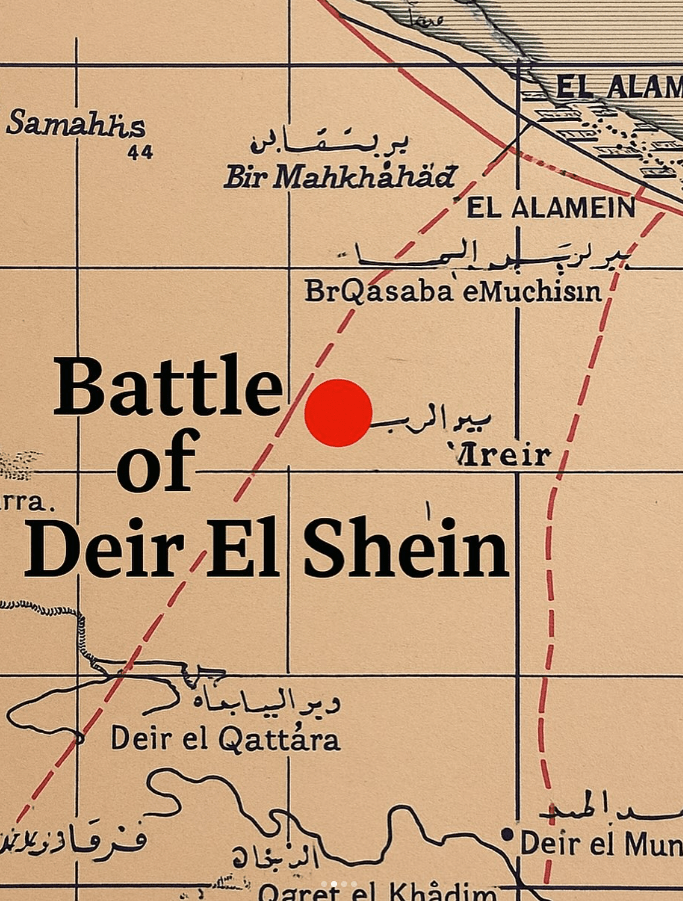
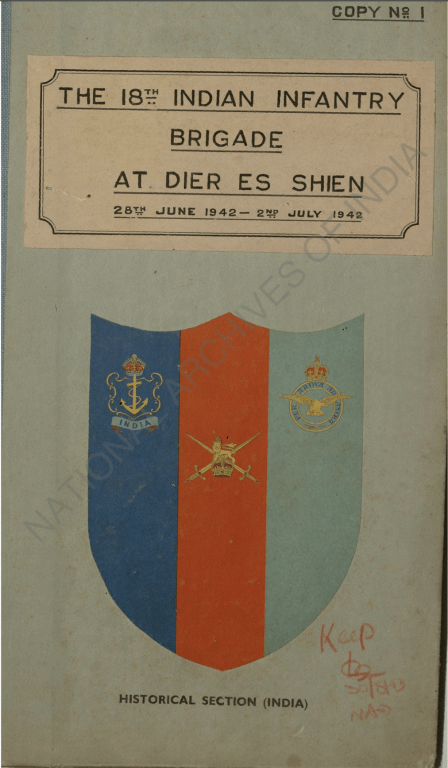
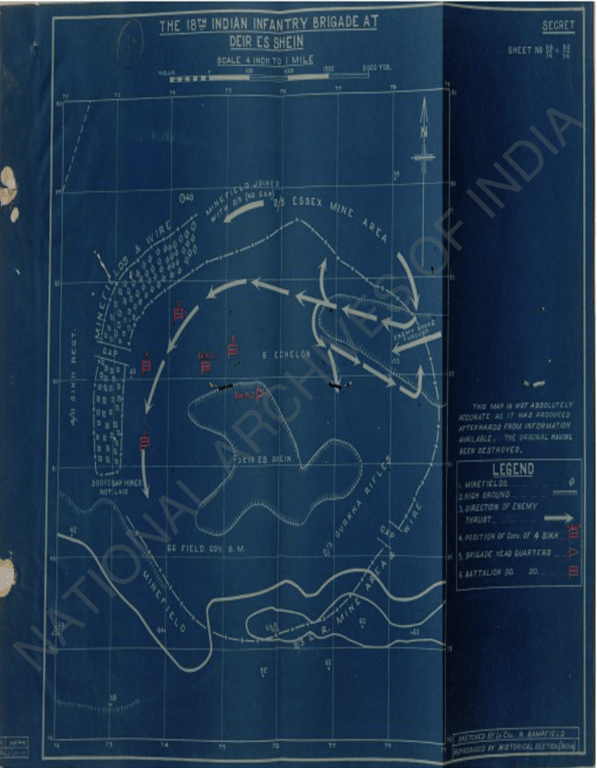
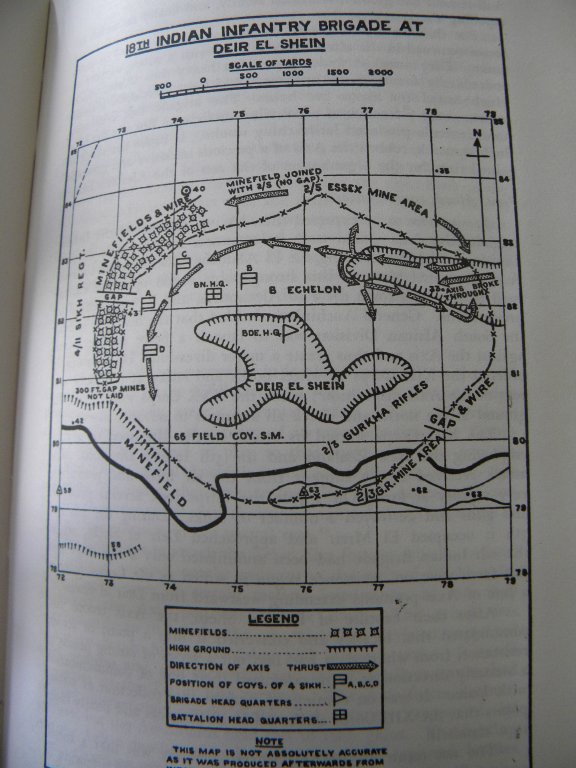
Map of 18th Indian Infantry Brigade at Deir el Shein
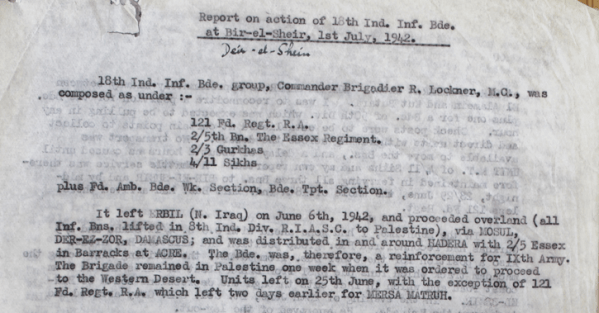
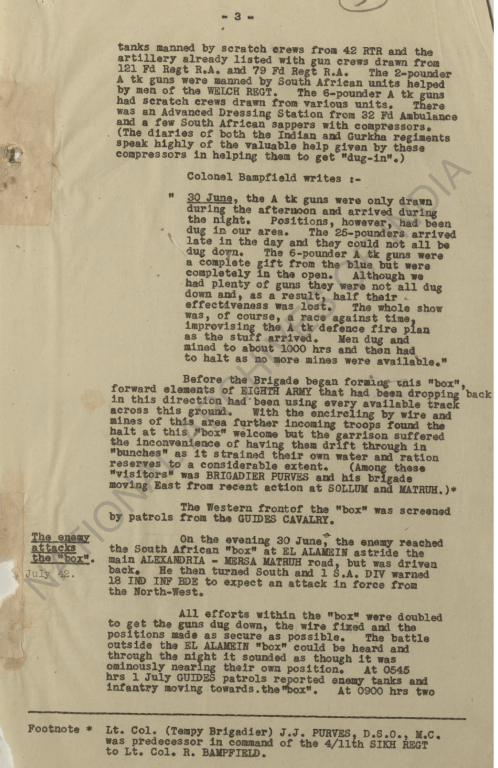
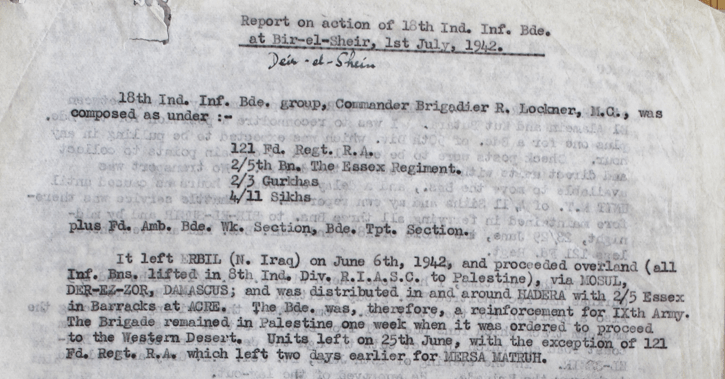
In an extract from a Post submitted to WW2Talk entitled “Deir el Shein sources – July 1942” we see from the War Diary of the 4/11 Sikh Battalion that the Brigade consists of the following, which ties in nicely with the Diary (above) of 2/5th Bn. of the Essex Regiment submitted by Lieut. Col. K.F. May: –
In the box itself were –
2/5 Essex,
4/11 Sikhs,
2/3 Gurkha Rifles,
66 Field Coy S & M,
4 medium M.G. manned by the Cheshires,
7 Matilda tanks manned by scratch crews from 42 R.T.R.
while the arty consisted of 18 (?) 25 pdrs manned by 121 Field Regt & 79 Field Regt,
approx 20 2 pdr A/Tk guns manned by unit’s, South Africans & some of the WELSH Regt
also 16 (?) 6 pdr A/Tk guns manned by ?
In addition of course was an Advanced Dressing Station (A.D.S.) from 32 Field Ambulance & some S.A. sappers with compressors.
I’m also learning from my WW2Talk friends of some of the participants both in the 2/5 Essex and also that of the 32nd Field Ambulance, both of which were there in support of 18th Indian Infantry Brigade. Firstly, a wonderful epitaph from the son of a Doctor with the 32nd Field Ambulance.
This is remembering all doctors & medical staff and the contribution of the Indian Army throughout WW2. “My dad, a doctor, already a veteran of Dunkirk, was promoted to Acting Lt Col on 22nd June 1942 to become Commanding Officer of the 32nd Field Ambulance attached to the 18th Indian Army Brigade. They played a critical role in the Battle of Deir el Shein on 1 July 1942. This engagement marked the beginning of the First Battle of El Alamein, where Axis forces under General Erwin Rommel attempted to break through to Alexandria. The 18th Indian Brigade, recently arrived from Iraq, was ordered to hold a defensive position at Deir el Shein to delay the German advance. The 32nd Field Ambulance established its main dressing station close behind the infantry positions, within range of artillery and tank fire. Throughout the day, the medical officers and orderlies worked under intense bombardment, treating wounded men from both the brigade and neighbouring units. Despite heavy shelling and repeated attacks by tanks and aircraft, the unit continued to operate until overrun in the late afternoon. When German armoured forces broke through the defensive perimeter, the 18th Indian Brigade was effectively destroyed. Most of the 32nd Field Ambulance’s personnel, including medical officers, were killed, wounded, or captured. Only a handful managed to withdraw eastward to regroup with Eighth Army medical formations. Their stand at Deir el Shein delayed Rommel’s advance by nearly a full day, allowing British and Commonwealth forces to organise the El Alamein defensive line. This delay proved decisive in halting the Axis drive toward Egypt and contributed directly to the later Allied victory at El Alamein. My father unlike many of his colleagues survived to rejoin other 8th Army medical units, to then serve in Burma, and after D day in Germany responsible for a Displaced Persons Camp for 14,000 persons.“
Lt. Col. Berkley – Commanding Officer of 32nd Field Ambulance.
At the 2nd Battle of El Alamein – “…he took command of a field ambulance/casualty clearing station after his senior officer had a breakdown, this was attached to an Indian Army division. In the chaos and fog of war the vehicles got lost, and were captured by retreating troops of the Afrika Korps. He worked alongside German doctors, who had large numbers of wounded; to treat all patients according to medical need. In return his captors agreed they would release them. The following morning this agreement was honoured, their German guards had gone.“
“We owe a debt to men like your father & mine. Their experience needs to be known, and understood for all generations.” Thank you Miles I couldn’t have said it better myself.
The story of the 2/5 Essex seems somehow even more harrowing –
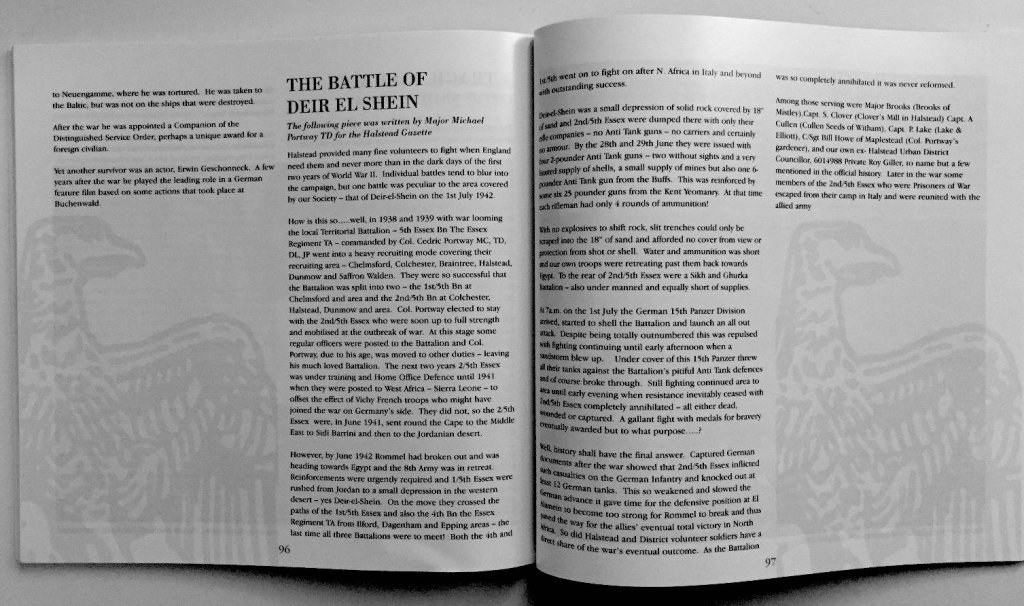
“Deir-el-Shein was a small depression of solid rock covered by 18 inches of sand and 2nd/5th Essex were dumped there with only their ****? companies – no Anti Tank guns – no carriers and certainly no armour. By the 28th and 29th June they were issued with four? 2-pounder Anti Tank guns – two without sights and a very limited supply of shells, a small supply of mines but also one 6-pounder Anti Tank gun from the Buffs. This was reinforced by some six 25 pounder guns from the Kent Yeomanry. At that time each rifleman had only 4 rounds of ammunition!“ Written by Major Michael Portway for the Halstead Gazette.
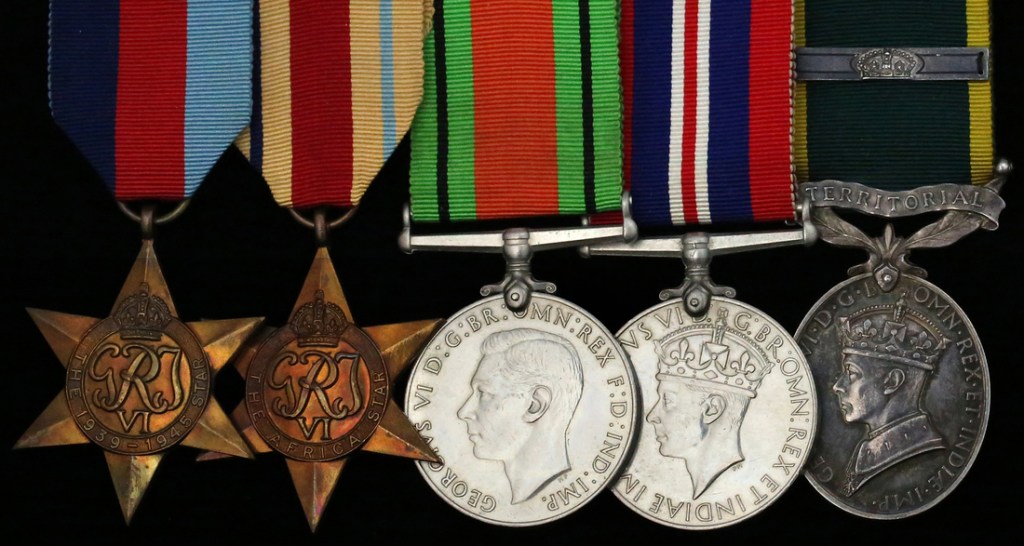
The above information is supported by Post No. 369 of the same WW2Talk Thread about Deir el Shein which links to the Auction of a set of medals awarded to the Company Quarter-Master Sergeant W. H. Howe, Essex Regiment, who was taken P.O.W. after the 2/5th Battalion’s gallant last stand at Deir-el-Shein on 1 July 1942.
William Harry ‘Bill’ Howe, a native of Great Maplestead, Essex, was born on 24 August 1907. A gardener by profession, he enlisted in the 5th Battalion, Essex Regiment (Territorials) in October 1925. Mobilised in September 1939, the Battalion was embarked for the Middle East in December 1940 and served in Palestine and Iraq in 1941-42. Following his capture at Deir-el-Shein on 1 July 1942, Howe was held at Fermo in Italy prior to being transferred to Stalag 4B at Muhlberg, on the Elbe in September 1943. He was finally liberated in April 1945.
It is accompanied by an extract of the same page above: –
‘Deir-el-Shein was a small depression of solid rock covered by 18 inches of sand and 2/5th Essex were dumped there with only their rifle companies – no anti-tank guns, no carriers and certainly no armour … with no explosives to shift rock, slit trenches could only be scraped into 18 inches of sand and afforded no cover from view or protection from shot or shell … At 7 a.m. on 1 July 1942 the German 15th Panzer Division arrived and started to shell the Battalion and launch an all out attack Despite being totally outnumbered this was repulsed with fighting continuing until early afternoon when a sandstorm blew up. Under cover of this 15th Panzer threw all their tanks against the Battalion’s pitiful anti-tank defences and, of course, broke through. Fighting still continued area to area until early evening when resistance inevitably ceased with 2/5th Essex completely annihilated – all dead, wounded or captured.’ Accompanying article by Major M.C. Portway, T.D., refers.
Also at Deir el Shein with 2/5 Essex was Stanley William DOWLING –
My dad was a private infantryman in 2/5 (TA) Essex Battalion. He joined up around Nov 1939 and initially had training at Warley Barracks near Brentwood. His army number was 6018306.
He sailed to Egypt via Freetown and Durban and I believe arrived in North Africa in late July 1941. He was in MEF 27th General Hospital in Aug ‘41 with rheumatic fever.
10 months later I think he was in the Battle of Deir-El-Shein near El Alamein where he was taken prisoner. Initially he was kept in a camp in Benghazi where he contracted amoebic dysentery and malaria; next I have a record that he spent 7 months in Caserta Military Hospital, Naples before being transferred to POW Camp Sforzacosta near Maserati, Italy.
For more on 2/5 Essex see – WO169/5013 – 2/5th (East) Bn The Essex Regiment On cover:- Jan – May 42 WD. 2/5 (East) Bn, The Essex Regiment, 18 Indian Infantry Brigade, 8 Indian Division. In Jan 1942 they were in Mosul. There was no narrative for Feb 42, and by March 1942 they had moved to Erbil, moving to Baquba on 18th March. They moved back to Erbil on 22 April 1942 and were still there on 31 May 1942. May – “Final – Reduced to cadre and finally dispersed in Jan 1943”.
WO 169/4006: XIII Corps (G Branch) June to August 1942.
Following 2/5th Essex account of being overrun at Deir el Shein on 1/7/42
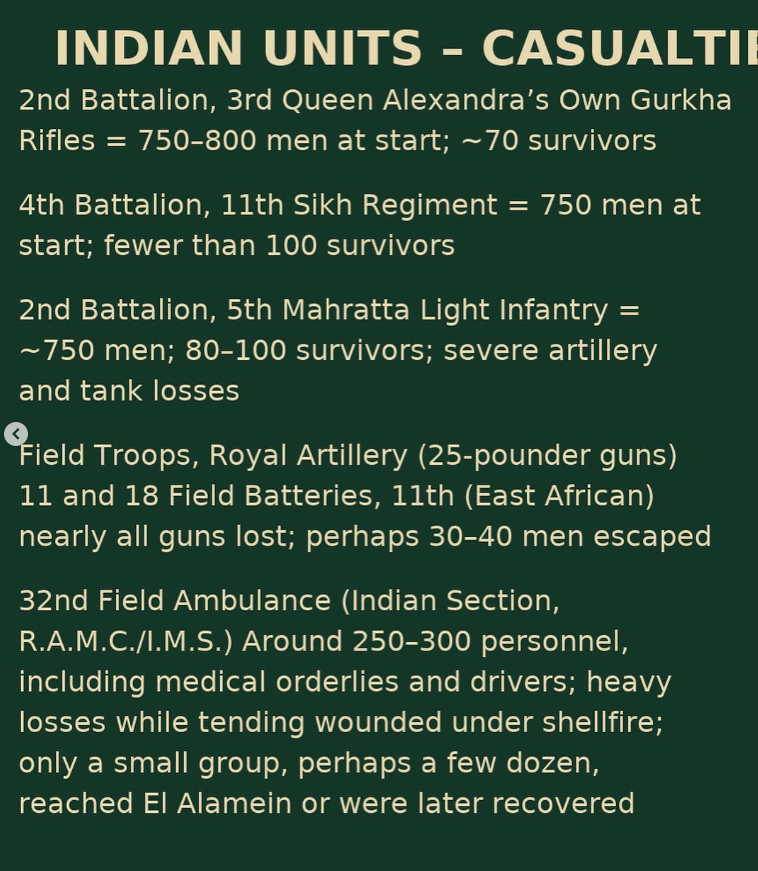
“As for the 18th Brigade at Deir el Shein, the 4/11th Sikhs were on the NW of the box, the 2/5 Essex on the NE, the 2/3 Gurkhas on the E in a semi circle, and the 66th Field Company of Sappers & Miners on the SW. They were supported by 7 Matildas of the 42nd Royal Tank Regiment, 4 medium machine guns of the Cheshire Regiment, 2-pounders and 6 pounders manned by South African and Welsh units. Oh, and the 32nd Field Ambulance had an Advanced Dressing Station too. Sorry, I don’t really remember all the other units outside of the main battalions of the 18th Brigade since there was a huge mess in setting up the box, the 18th Brigade had no signal equipment, very little ammunition, and the supporting artillery came in too late and because the area of Deir el Shein was bedrock, there was not enough time to dig the guns in. As for the result of the battle, the Sikhs were overrun at 1730 hours, the Gurkhas at 1900 hours and Essex by 1930 hours. The Sikhs lost 3 officers and 370 other ranks with 7 officers and 500 other ranks missing. The Gurkhas lost 12 officers and 580 men, not sure of how many missing, but their commanding officer was captured.“
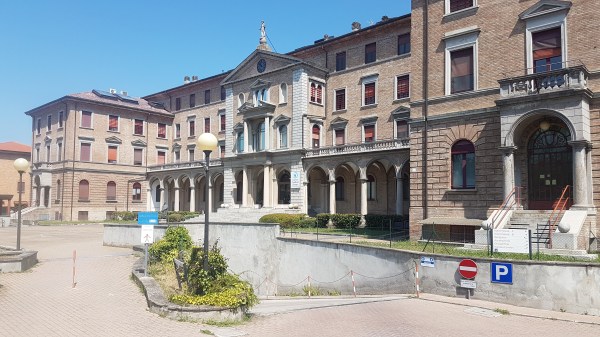
Unlike the movie of the same name, coincidentally my favourite ever war movie and there were a few when I was growing up, the escape plan I have heard most about, associated with PG 49 at Fontanellato, is the escape by just a handful of prisoners from the sports field at the rear of the Orphanage.
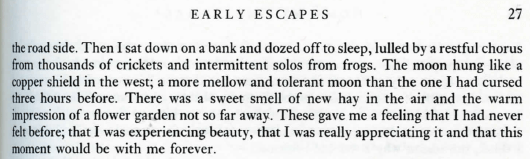
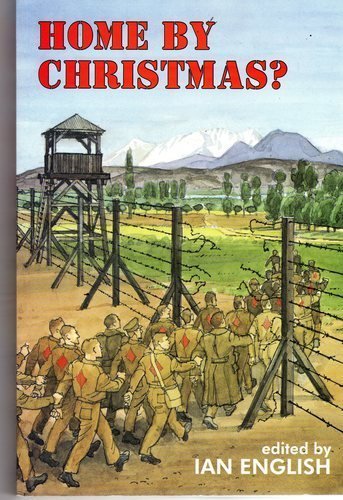
I had come across brief mentions of the escape in a number of the POW stories that largely crop up from posts on the Monte San Martino Trust website but, having kindly been gifted a copy of “Home by Christmas?” edited by Ian English, I finally get to read an authorized version of events by one of the men involved in the Escape.
Chapter 2 of that book is entitled “Early Escapes” and it provides us with a great insight into the mindset and the challenges of men incarcerated after their capture, and the Main Cast comprises of the following:-
Graham, D.S. (Dominick Stuart or “Toby”), Capt., R.A. (106681) – The Author/Narrator
Duke, D.O.C. (Denis), Capt., R.A. (91775) – who organised the ‘Escape Committee’
Roncoroni, A.D.S. (Tony), Capt., R.A. (100946)
Joscelyne, P.J. (Peter), Capt., R.T.R. (164126)
Day, G.M. (Jimmy), Lt., Welch (94508)
Ross, M.P. (Michael), Capt., Welch (137366)
Supporting ‘Actors’ of the Cast and Crew include:-
Hope, H.A. (Hugh), Maj., K.R.R.C. (65415) – who made the papier-mâché ‘dummies’
Comyn, J.A. (Jack), Lt., R.A.C., (66066) – involved in a later, again unsuccessful, escape attempt.
The great thing about this Chapter of Ian English’s book is that it confirms for me that every one of the above men were all in PG 49 at Fontanellato with my Dad.
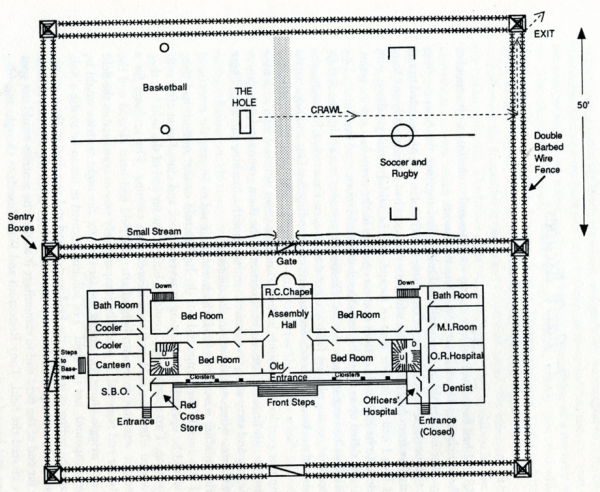
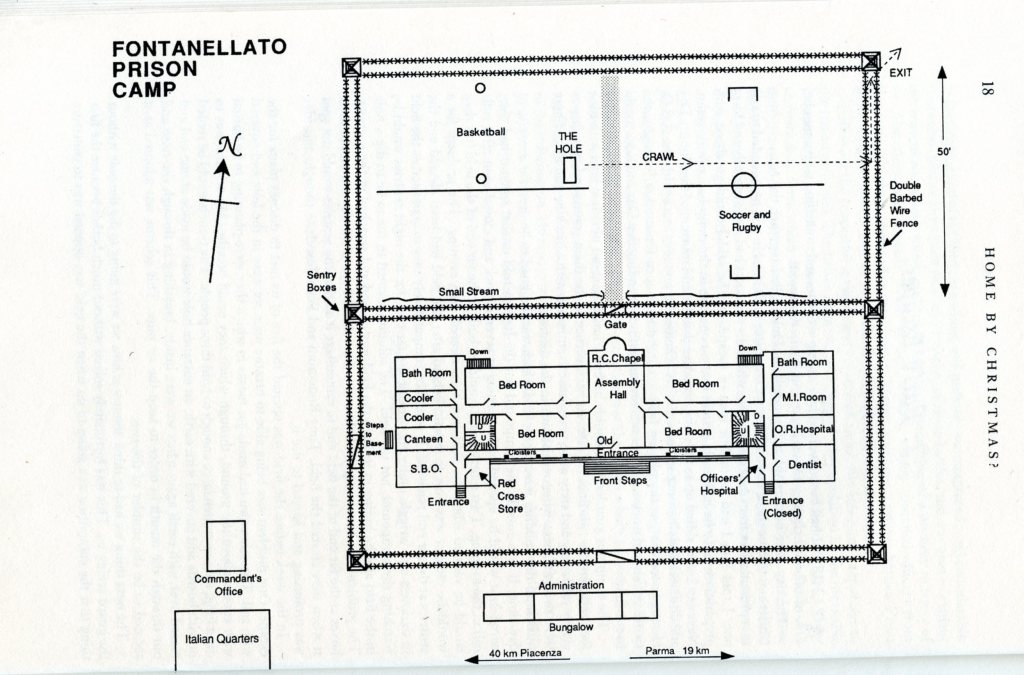
Map of the Prison Camp (PG 49) and the location of the Escape
I’m so pleased to have finally received a copy of this fascinating book as it gives me a real sense of the atmosphere that would have prevailed in this camp, which my Dad must have experienced first-hand. And, whilst I will always be drawn to watching Steve McQueen and all the other wonderful characters that came together in that epic film again and again, I can’t help but feeling the raw energy that emanates from the pages of this Chapter as the individuals experience the tension, fear and even more extraordinarily, the sense of freedom whilst walking just outside of the camp after their escape and still not knowing what dangers lay ahead.
“There was a sweet smell of new hay in the air and the warm impression of a flower garden not so far away. These gave me a feeling that I had never felt before; that I was experiencing beauty, that I was really appreciating it and that this moment would be with me forever.”
One of the great things about being handed a ‘Gift’, such as this book that I recently received, edited by Ian English, entitled “Home by Christmas?”, is that it feels as though it provides me with an entirely fresh set of paints with which to paint my picture.
For me, learning about where my Dad was during the period 1939-1945 and reading about the people that he was with during that period, is helping me to picture what life was like for him during this tumultuous period in our history.
And so, when pouring through the pages of this book I can’t help but stop to dip my paint brush into the names and events that pop up on each page. And I find myself confirming things such as, yes this person does appear in my Roll Call, or that person performed this role in the Camp and, goodness, that’s what his nickname was. And so they become real people. Not just epitaphs, but REAL people. And part of me wants to be there.
And one of the greatest benefits of being handed this new box of paints is that it unearths, or maybe just cements for me, the role that these men played in this very poignant time in our lives. And I am thrilled when I see names popping out of the pages that I’m reading of this 1997 Edition of the book Edited by Ian English, of “Home by Christmas?”: –
and immediately Page 13 starts off with Peter Langrishe describing the setting of PG 49 at Fontanellato, explaining that “Behind was a field about 2 acres in size which we were given permission to turn into a playing field. Here rugby, soccer and basketball were played with gusto….. It later provided the opportunity for a small number of inmates to escape, as described by Toby Graham…”
It goes on to portray that “The prisoners enjoyed a tolerable standard of living due mainly to the expert catering ability of Lieut. Leon Blanchaert, a Belgian serving with the British army who spoke six languages, including Italian.“
And, their “allotment of Red Cross Parcels – one per man per week – was not distributed individually, but was taken into a central store under the control of C.D. ‘Kit’ Patterson…“
Also, “A popular venue was a bar run by Tommy Pitman, which opened for late morning and evening sessions. One could buy vermouth which was drinkable and either the cheap vino ‘molto ordinario’ which was quite dreadful, or more expensive wines, always provided one had the wherewithal.”
And further on “An amusing and interesting feature of camp life was the activities of ‘Opportunities Ltd.’ or ‘Opps’. This was a loose organisation run by Pilot Officer Bill Rainford or ‘Rainy’ as he was known. ‘Opps’ provided a multiplicity of services, for which he charged 10%, such as tailoring, watch repair, recovery of cigarette lighters dropped down loos, exchange of clothing, and also chocolate and cigarettes; in fact, almost anything except a means of escape from the camp.”
Also present were of course:-
Lt.-Col. Hugh Mainwaring who had been G.S.O.1 (Operations) at 8th Army Headquarters.
And the American journalist named Larry Allen, who had been on H.M.S. Ark Royal when she was sunk in the Mediterranean.
So, quite apart from being a great read, this book is confirming for me so many details, not only of life in the camp, but the men and the roles they played in its day-to-day function,
Following on from my first Post about Deir el Shein and, as I continue to stumble upon fragments of my father’s wartime story, I’m starting to piece together the lives of so many men that he was ultimately to become associated with in PG 49 at Fontanellato. But how had it amounted to this?
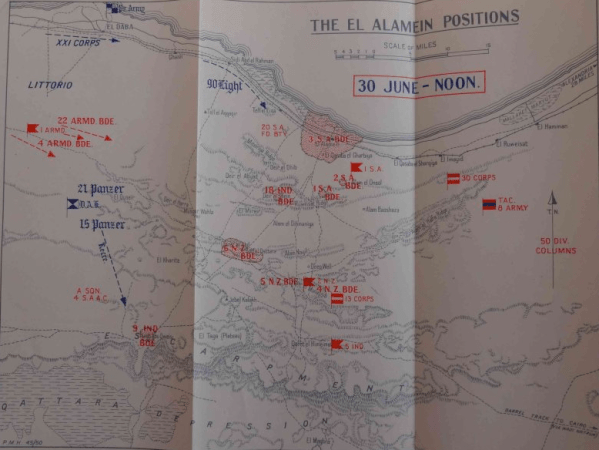
“When General Norrie assumed command of the [Alamein] Line, after handing over Matruh on 23 June, he was disturbed by the wide gaps between the three fortified positions, but could do little with the troops at his disposal. Even the original boxes could not be adequately held, but he did try to fill the gap between El Alamein and Bab el Qattera by the establishment of a new position at Deir el Shein, which he assigned to 18th Indian Infantry Brigade…” – From Crisis in the Desert, p.272
“Officer Commanding 18th Indian Infantry Brigade Signal Section. WWII. Western Desert Campaign. Published citation: In recognition of gallant and distinguished services in the field. No recommendation—For his conduct at Deir el Shein on 1 July 1942 in the First Battle of El Alamein during the Western Desert Campaign prior to being captured when the brigade was overrun.” From a footnote:Captured in the Western Desert on 1 July 1942 and held in Italy at Campo 49 (Fontanellato) and at Oflag 79 atBrunswick, in Lower Saxony, Germany. (LG 11 April 1946; 37528, p. 1835.)
“So, was this when my Dad was captured in the Desert too?”
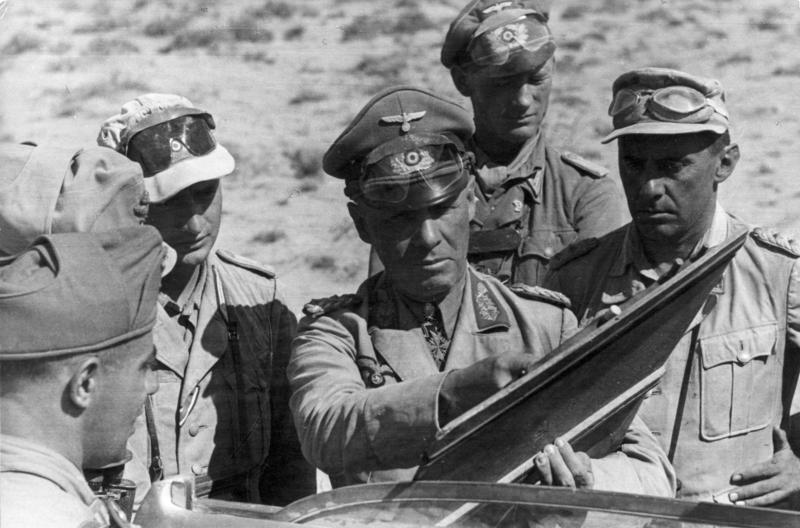
It’s very clear that 4/11 SIKH REGT is at the North West corner of this “Box” at Deir El Shein, 16 miles south of El Alamein, and I’m getting the distinct impression that my Dad is at the sharp end of an inevitable thrust by the Desert Fox, Erwin Rommel, himself.
A further Google search brought up something called the Feldgrau Forum providing information about:-
“As for the 18th Brigade at Deir el Shein, the 4/11th Sikhs were on the NW of the box, the 2/5 Essex on the NE, the 2/3 Gurkhas on the E in a semi circle, and the 66th Field Company of Sappers & Miners on the SW. They were supported by 7 Matildas of the 42nd Royal Tank Regiment, 4 medium machine guns of the Cheshire Regiment, 2-pounders and 6 pounders manned by South African and Welsh units. Oh, and the 32nd Field Ambulance had an Advanced Dressing Station too. Sorry, I don’t really remember all the other units outside of the main battalions of the 18th Brigade since there was a huge mess in setting up the box, the 18th Brigade had no signal equipment, very little ammunition, and the supporting artillery came in too late and because the area of Deir el Shein was bedrock, there was not enough time to dig the guns in. As for the result of the battle, the Sikhs were overrun at 1730 hours, the Gurkhas at 1900 hours and Essex by 1930 hours. The Sikhs lost 3 officers and 370 other ranks with 7 officers and 500 other ranks missing. The Gurkhas lost 12 officers and 580 men, not sure of how many missing, but their commanding officer was captured.” – by DocAmerica Sun Aug 28, 2011: Moderator John W. Howard
One of my few recollections of my Dad talking about his wartime experiences was a very brief reference to suddenly being surrounded by German forces somewhere in the middle of the desert, ultimately leading to becoming a Prisoner of War in Italy. But that was it and how I wish I had pushed for more information then rather than looking now for lots of little needles in this vast haystack.
I already know that the very first post written by Tom O’Brien on Deir el Shein sources – July 1942 had identified the following list of 10 British Officers present with the Battalion on the midnight of 30/6/42. Sourced from WO169/7773 – The Battalion Diary of 4/11 Sikh Regiment. Commanding Officer – Lieut. Col. R. Bampfield.
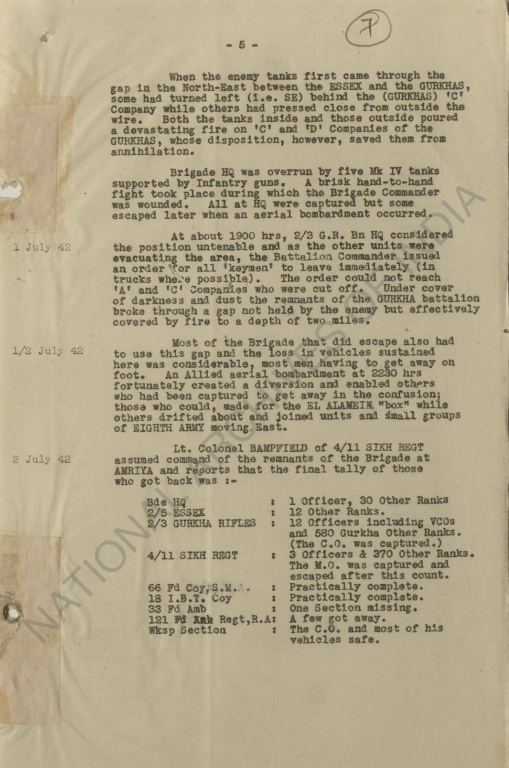
So, of the 10 British Officers of the 4th Battalion 11th Sikh Regiment listed above only 3 officers, together with 370 Other Ranks, were recorded as being present at Amriya on 2nd July 1942 when the Roll Call was carried out. And these appear to have been:-
T/ Capt. Simon Anthony Cunningham (S.A.C.) Trestrail2
2/ Lieut. Alan Cadell Barnes (A.C.B.) Wimbush
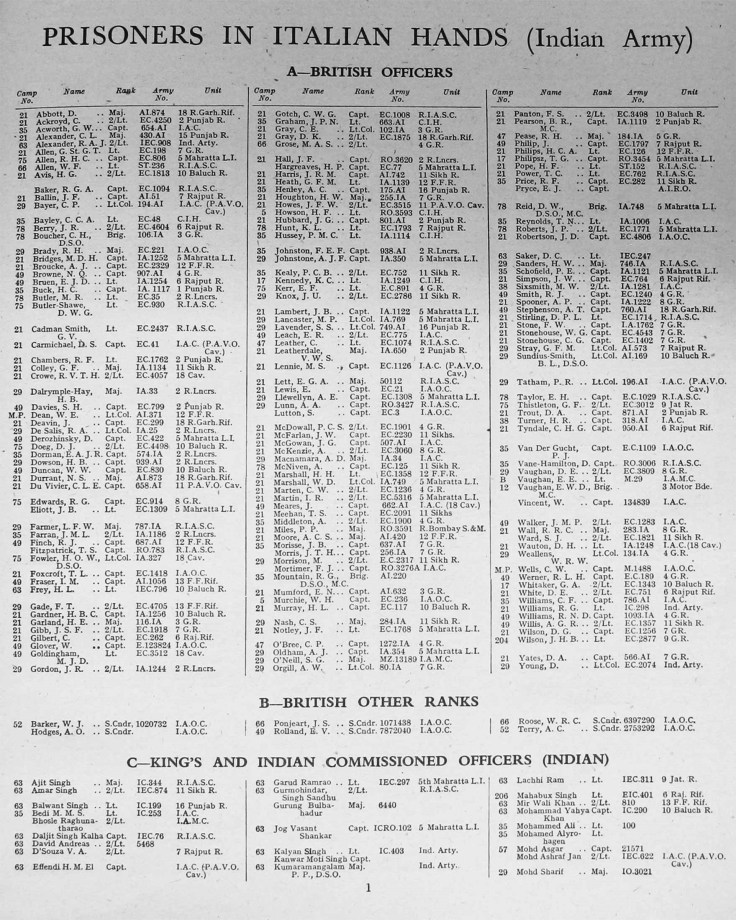
So, from that do we have to deduce that the following 7 British Officers were captured at Deir el Shein by the German forces on 1st July 1942? It certainly makes sense and when we look at the list of POW’s held in Italy what do we find?
A/Major G.F. Colley (M.C.) IA. 1134 – is at PG 21 Chieti in the Abruzzo region
A/Capt. J.R.M. Harris AI. 742 – is also at PG 21 Chieti in the Abruzzo region
2 Lieut. M. Morrison EC. 2317 – PG 29 Viano near Reggio
2/Lieut. S.J. Ward EC. 1821 – ??
2/ Lieut. J.U. Knox EC. 2786 – PG 29 Viano near Reggio
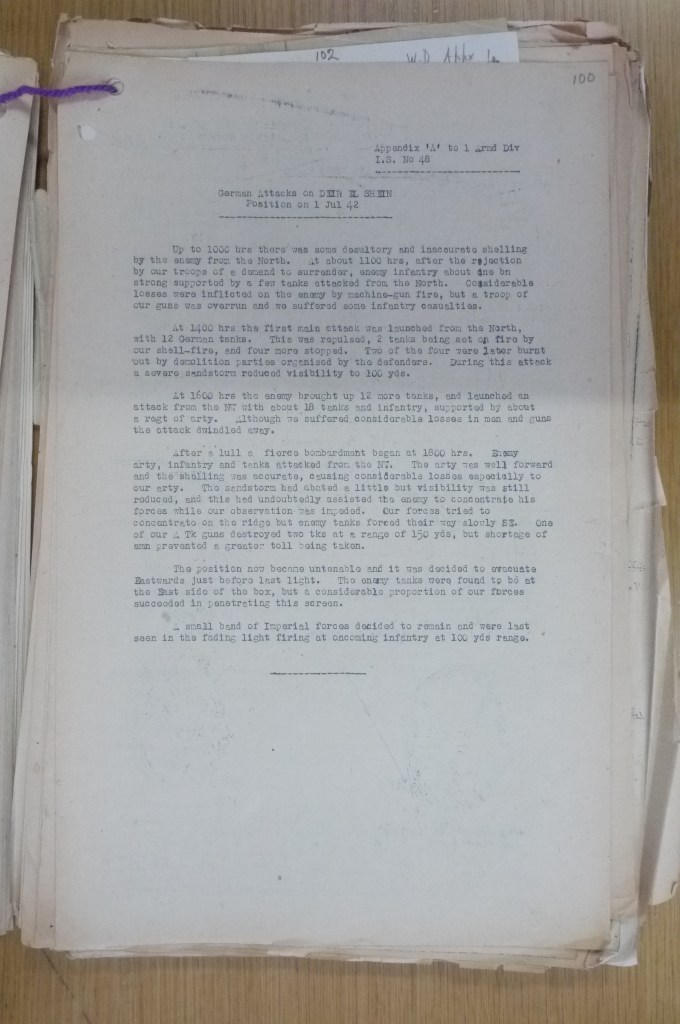
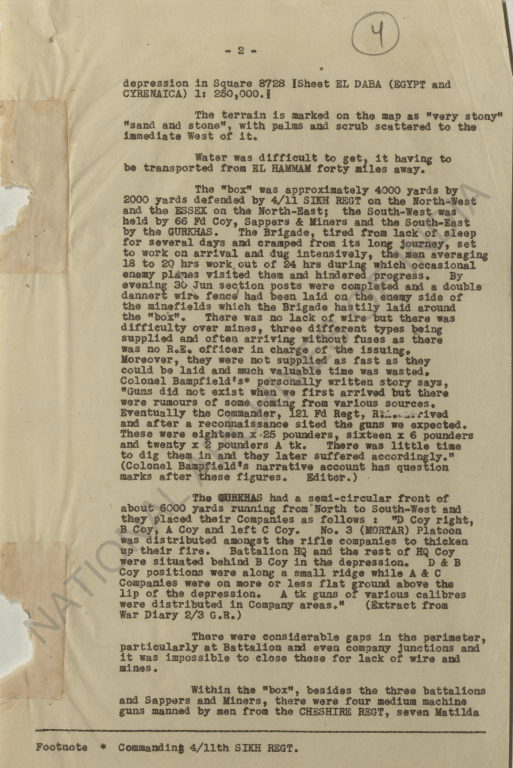
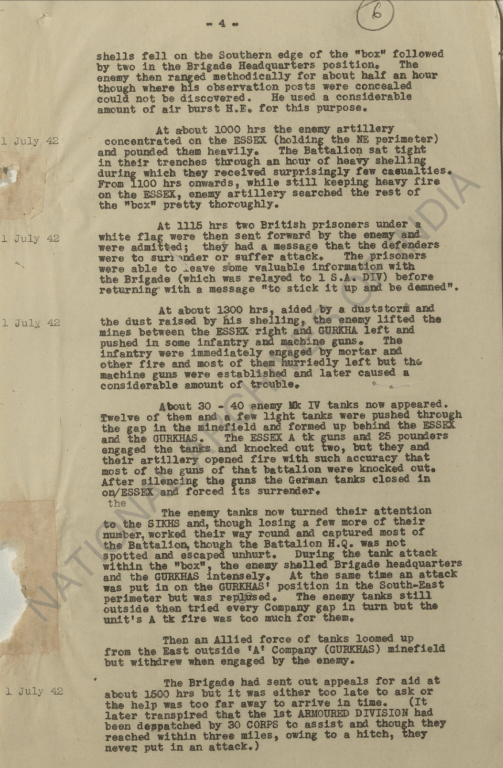
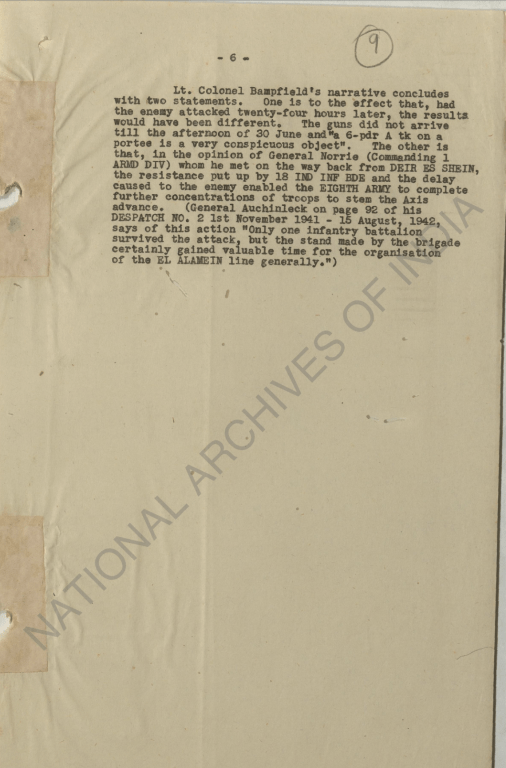
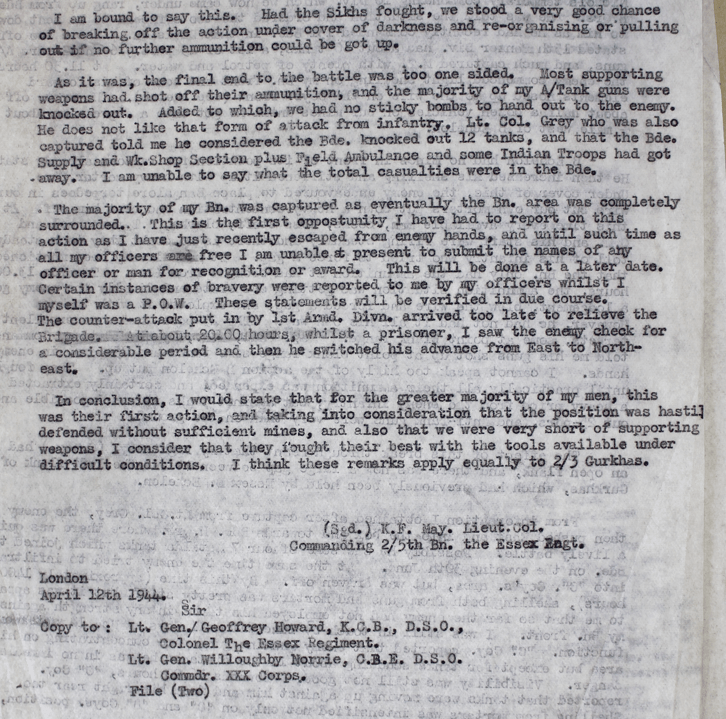
Having established that 2/5th Battalion the Essex Regiment were also present at Deir el Shein as part of the 18th Indian Infantry Brigade, I feel honour bound to post a document that I was lucky enough to come across in Post #19 on the WW2Talk website as part of the Thread relating to Deir el Shein sources – July 1942. A transcript was kindly provided and very much mirrors the Battalion Diary of 4/11th Sikhs that I first came across and posted under Another piece of the Jigsaw:-
……. although I’m pleased that some comments questioned the criticism levelled at the Sikh Regiment towards the end of the report.
Auchinleck’s Despatch No.2 (1/11/41-15/8/42) says on pg. 92 of the action:
‘Only one infantry battalion survived the attack, but the stand made by the Brigade certainly gained valuable time for the organization of the El Alamein line generally’.
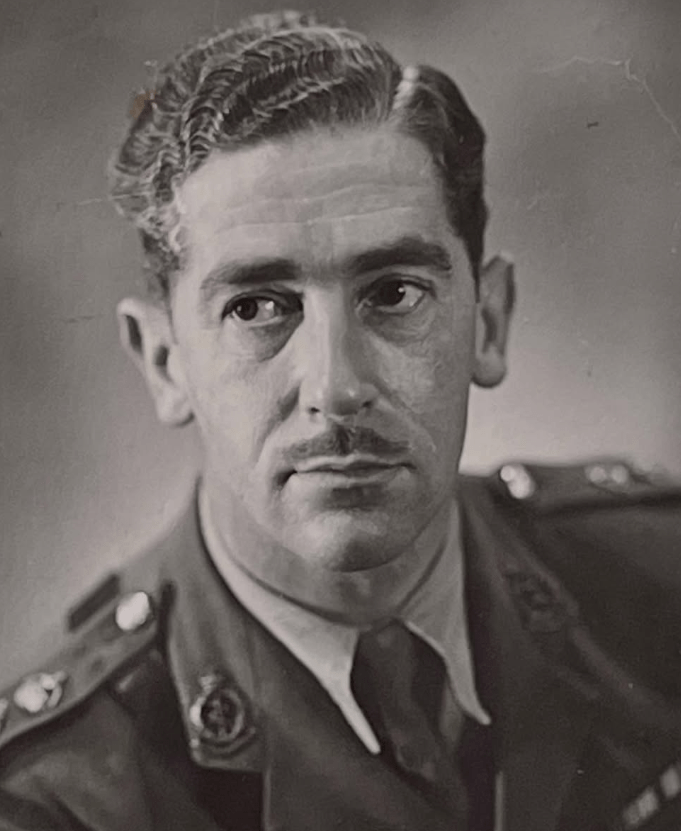
Richard Bampfield (13th August 1898 – 11th August 1964) was an English first-class cricketer and an officer in the British Indian Army. Bampfield was born at Frome in August 1898. He was educated at St Edward’s School, Oxford. From there, he went to British India to attend the Cadet College at Wellington, graduating from there into the British Indian Army as a Second Lieutenant in June 1917, with him seeing action in the final fifteen months of the First World War. By December 1919, he held the rank of Lieutenant and acted in the capacity of an aide-de-camp until February 1920. Promotion to Captain would follow, with a further promotion to Major coming in June 1935. Bampfield was a member of the 11th Sikh Regiment and spent time as an instructor at the Indian Military Academy beginning in July 1937. Bampfield would serve with the 11th Sikh in the Second World War, seeing action in the Middle East campaign for which he was mentioned in despatches in December 1941. He was promoted to Lieutenant-Colonel during the war in June 1943. He retired from active service in September 1948, three years after the end of the war and a year after Indian Independence; the latter event had seen him transferred to the specialist list of the British Army. Bampfield died at Rustington on 11th August 1964, two days before his 66th birthday. ↩︎
I first started dabbling with Family Research back in 2008 when I became curious about my partner Rex’s family origins in that his family name was Blanchette, which clearly sounded very French to me, and he had indicated when we first met that the only thing he had heard about his origins was that mention had been made of the family coming to New Zealand from Guernsey. As I had spent quite a chunk of my life in its sister isle of Jersey I was obviously intrigued. And so, my Genealogy journey began, and what a fascinating series of events unfolded.
But it wasn’t till much later that I started to wonder if there was anything as interesting that I could unearth in my Family History? Sadly by then my father, who had been working in Ceylon at the outbreak of WW2, had died and I was very conscious that my Mum’s memory was starting to fail. As I mentioned in my first Post “How it all Started…..” my Mum had provided me with the start of the paper trail leading to this website when she told me that Dad had been a POW at Fontanellato.
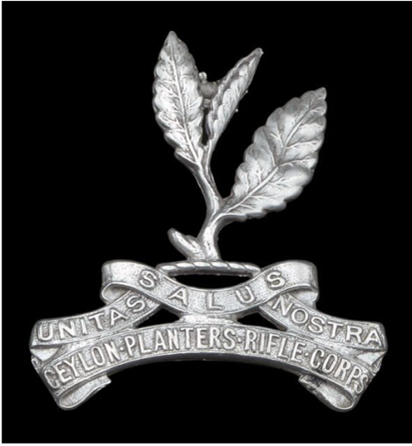
“When storm clouds gathered in Europe and war became inevitable all the young British tea planters and brokers were expected to join the volunteer regiment, the Ceylon Planters Rifle Corps (their cap badge was a tea leaf) and, when war broke out, they shipped up to India, where he enrolled in the 4/11 Sikh Regiment and was soon on his way to Egypt. He was one of 33,000 Allied troops captured at the fall of Tobruk in 1942 but escaped on his first night of captivity and, after two weeks during which he was given food and shelter by Bedouin tribes, made his way back to Allied lines on foot. Captured a second time he was sent to a POW camp in Italy where he escaped again and, for 6 months, found shelter with Italian communist villagers in the hills of Tuscany.” N.T.G. Willis
Fast forward a few more years, and with help from my brother Graham giving me hints, tips and photos as to Dad’s wartime exploits, I stumbled upon the Monte San Martino Trust (MSMT) website after my Genealogy research unearthed a snippet of information about where Dad was a POW. So, on 26th November 2018 (wow 7 years ago!), I reached out to the MSMT with the following email: info@msmtrust.org.uk.
While researching the MSMT website I had noticed, rather sadly, that I had started my research just a few months too late, as the Trust had only just returned from a 75th Anniversary celebration of the Italian Armistice held on 7th-9th September 2018 at none other than the site of my Dad’s POW Camp (PG49) at Fontanellato! But I was soon cheered up when I rather unexpectedly had a wonderful response from Christine English, a Trustee of the MSMT who straight away confirmed that my Dad had indeed been a POW in Fontanellato. And not only that but her father had written a book about the Camp and Dad appeared in the Nominal Rolls at the back of the book. Even today it still feels like I had suddenly won the Lottery.
But, living in New Zealand, I soon discovered that purchasing this little nugget of information and having it posted to me was “beyond my ‘ken”. But now, some 7 years down the track and thanks to the kindness, willingness and generosity of another son of a PG49’er, I am now thrilled to be in possession of the very book that proves beyond doubt that my father was a POW in Fontanellato.
And not only that but it appears that Appendix 8, entitled “P.G.49 Fontanellato: Nominal Rolls, September 1943” at the back of the book, could provide me with a list of all the soldiers who marched out of that Camp on 9th September 1943. So now it seems I actually do know who all these extraordinary men are who were with my Dad when they, together with approximately 20,000 others across the whole of Italy, all dispersed into the Italian countryside after the Italian Armistice. And now all I have to do is, hopefully, find some of the relatives of these Italian families who helped feed and shelter my Dad as he attempted to make his way back to friendly territory.
When I first started to find stories written by Servicemen who had been POW’s during World War II, I was immediately disappointed that I had never come across anything put in writing by my father. That’s not to say that he didn’t put pen to paper, but I’ve certainly not found anything so far and it seems unlikely that I ever will.
But, whilst it has been thrilling to stumble upon numerous tales, either written in the form of books or reports and even diaries, I’m beginning to realise that there are probably more stories that haven’t been told or passed on to the families of these men. And it’s only when I receive notification from my website that there are others, like me, who never knew or talked about their father’s involvement in this moment in history that I realise that I am not alone. None more so than the notification I received recently from Nigel Collins:-
“Hi – I have just discovered your website. I have no idea if this information will be of any use or interest.
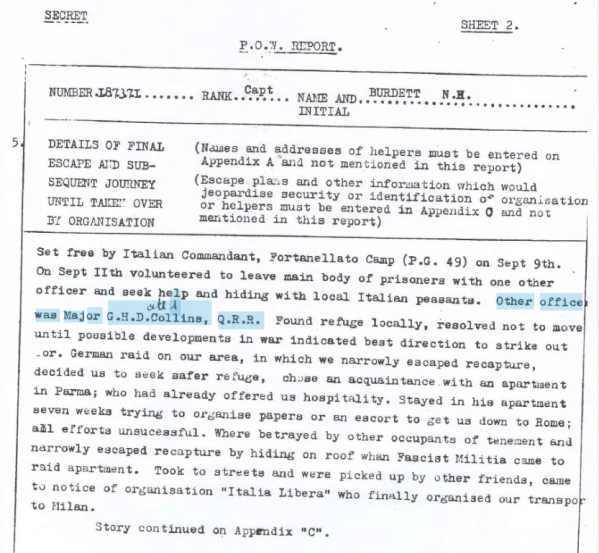
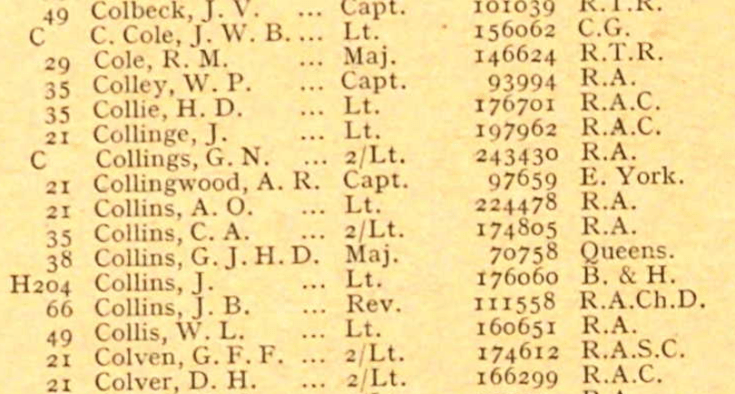
My father, Major Geoffrey (GJHD) Collins was in PG 49 Fontanellato having been taken prisoner in North Africa. My knowledge is a bit sketchy, as, like so many servicemen who fought in WWll, he didn’t talk about it much.
I do know that at the time of the Armistice he travelled north with fellow prisoner Noel Burdett, eventually reaching Switzerland. The stories of that time are fragmented; I know they were sheltered by a man called Nando (?) and his family (in Parma itself I think). There were a lot of scrapes on the way – hiding under things in lorries, in ditches, cornfields, jumping on to the roof – and crossing the Alps in snow, which as a schoolboy learning Latin, I was disappointed to find was not quite the same as Hannibal’s trip! He stayed in Switzerland until he returned to England in March 1945, and I have no idea what he did there. My mother thought it was something to do with Intelligence, but I have been unable to find out anything. Snippets of his story appear in the book Home by Christmas? edited by Ian English which was published in 1997, sadly some years after my father’s death.“
My immediate thought when I received this correspondence was that I needed to see if Nigel’s father appeared on my site, but a quick search drew a blank, which I thought was odd. So, I decided to search for his “fellow prisoner Noel Burdett” and I was quite surprised to find that I had previously stumbled upon his story under the Monte San Martino Trust Archives. And sure enough, a quick search on that story indicated that a Major G.H.D Collins. Q.R.R. [Queens Royal Regiment] had been a travelling companion of Noel Burdett following the release of the POW’s from PG 49 at Fontanellato at the time of the Italian Armistice. Surely this must be Nigel’s father? So, I wrote back to Nigel with my find, thanking him for reaching out to me about his Dad:-
“I couldn’t find your Dad initially when I looked under my Roll Call (I assumed he was British Army) but then I searched through my list of Italian POW’s and found that he was listed as being in PG 38 when that document was compiled, so it’s now useful to know that some prisoners came from Poppi, near Arezzo, in the Tuscany Region of Italy. I hadn’t heard that before so that’s another piece of the puzzle as to how the numbers grew to over 600 at Fontanellato at the time of the Armistice.“
“I was also unaware of Noel Burdett’s story – thanks for the link. There were certainly bits in there which chimed with what I had heard; the jumping on to the roof, and hiding in a furniture lorry, and getting frostbite in the Alps for instance. The bit about concealment in charcoal drums was news, and I must say I’m a bit confused about that one! It was interesting to see their correspondence too.“
I’ve no doubt that Nigel and I will continue to correspond as it appears that we have so much in common. Especially as it appears that not talking about this period in their lives appears to be a very common theme amongst these men. And I’m guessing that all of them would be incredibly surprised to learn that we really would have loved to have heard more. Especially with regard to who all these wonderful Italian people were who helped them in what can only be described as harrowing times, often under threat of being shot for aiding and abetting prisoners on the run.
So, for the moment I close by saying…
“I’m thrilled that we are in touch and so pleased to hear that you had not come across the Noel Burdett story on the MSMT site. I haven’t managed to read through it all myself, but I thought it fascinating that there were communications exchanged between him and your Dad. So much more to find out about the whole North Africa shemozzle for these 2 men in our lives and what effect it had on them both.”
When I first found out that my father had been a POW in PG 49 at Fontanellato I immediately recalled that, during my childhood, he had briefly talked about living in the hills with an Italian family during a brief period of his wartime experience. But I knew nothing of how this had come about and so it is only when I come across some of the incredible stories archived by the Monte San Martino Trust written by others who were in the same Camp that I start to fully appreciate exactly when and how these events unfolded.
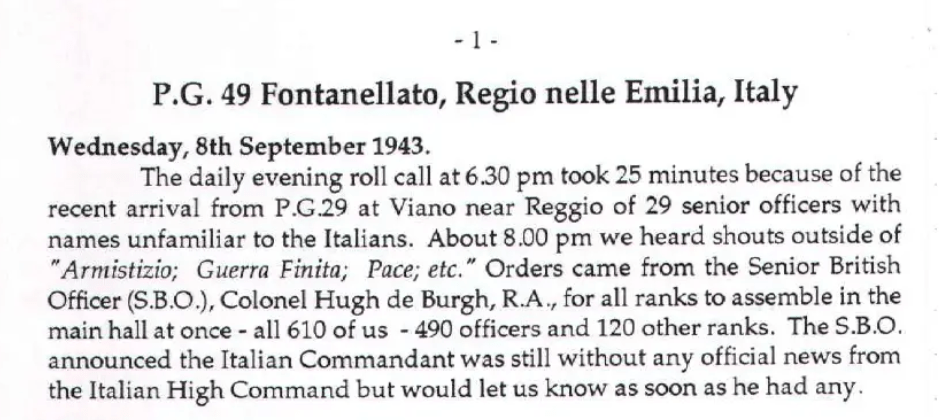
“The daily evening roll call at 6.30 pm took 25 minutes because of the recent arrival from PG 29 at Viano near Reggio of 29 senior officers with names unfamiliar to the Italians. About 8.00 pm we heard shouts outside of “Armistizio; Guerra Finita; Pace; etc.” Orders came from the Senior British Officer (SBO), Colonel Hugh de Burgh, RA, for all ranks to assemble in the main hall at once – all 610 of us – 490 officers and 120 other ranks. The SBO announced the Italian Commandant was still without any official news from the Italian High Command but would let us know as soon as he had any.”
Thursday, 9th September 1943
“After breakfast we were all told to parade in the courtyard. This time the SBO’s news was not so good: the Commandant expected German troops to seize the camp. He had patrols out. We were to put on our battledress, pack our kit on our beds, draw 24-hour rations and be ready to move at five minutes’ notice. He had offered our help to defend the camp but the Commandant had politely declined it.
I left my greatcoat and service dress uniform in the wardrobe of Room 63 and packed only washing and shaving kit, a pullover, scarf, gloves and some letters and family photographs. From the basement I collected my emergency rations – a tin of service biscuits, a meat roll, 2 peaches and a small bar of ‘Motta’ chocolate. I also took the remains of my Red Cross food parcel – sugar, cocoa, nescafe and a large bar of chocolate – and some cigarettes for barter.
During the morning Colonel Hugh Mainwaring, RA (one of the 20 Old Etonians in Fontanellato) and Captain Prevedini, the camp’s Italian security officer and interpreter, returned from their two-hour recce for a suitable hide-out. It seemed strange to see the latter, an ambivalent character, on our side. Before the war he was on the staff of Thomas Cook and spoke fluent English.”
The next paragraph produces some fascinating information, and the introductory sentence brings a smile to my face. My Dad’s favourite Sunday lunchtime drink was Gin and Dubonnet (I know it was the Queen Mother’s too!)
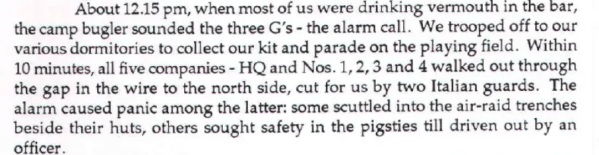
“About 12.15 pm, when most of us were drinking vermouth in the bar, the camp bugler sounded the three G’s – the alarm call. We trooped off to our various dormitories to collect our kit and parade on the playing field. Within 10 minutes, all five companies – HQ and Nos. 1, 2, 3 and 4 walked out through the gap in the wire to the north side, cut for us by two Italian guards. The alarm caused panic among the latter: some scuttled into the air-raid trenches beside their huts, others sought safety in the pigsties till driven out by an officer.”
The diary entry then goes on to explain in great detail with whom Tom was linked up with as they marched out of the camp:-
I was in No. 3 company, commanded by Lt. Colonel Peter Burne, 12th Lancers. My platoon commander was Major Donald Nott, DSO MC, of the Worcesters. Captain Ronnie Orr-Ewing (2nd Bn Scots Guards) was my section commander. Each section was in pairs – ours were Ronnie and Philip Kindersley (2nd Coldstream); Jack Younger (3rd Coldstream) and Richard Brooke (2nd Scots Guards); Carol Mather (Welsh Guards) and Desmond Buchanan (Grenadiers); and finally, Tony Kinsman (Grenadiers) and myself (3rd Coldstream). Between No. 3 Co. and No. 4 on our right rode Eric Newby in his Black Watch bonnet, riding on a fat horse led by an Italian soldier. Eric had fallen and broken his ankle two days earlier and could not walk. We crossed fields and vineyards and caught up with the SBO and his HQ party, moving on then into a sunken ditch below a grass bank and in thick undergrowth. This was the site chosen by Hugh Mainwaring. We spent the afternoon drying our sweaty shirts, eating grapes and waiting for news and orders.
We received our first news at about 4.00 pm and it was not good: 40 or so Germans had taken over the camp and captured the Commandant and all but two of his officers. They had seized all the livestock and then left. Jack Younger managed to use some of his escaping money to buy bread, eggs and wine from a nearby farm. Under cover of darkness a few officers decided to slip away despite the SBO’s advice to stay together.
Later that evening we learned that 200 German soldiers had raided the camp, eaten our lunch and thrown all our belongings out of the windows, auctioning what they did not eat, nor want to take with them. They had told the locals they would return in the morning to search for us.
Before dossing down for the night, we all moved further west into thicker cover. It was a very cold and sleepless night.”
This long and detailed story continues for page after page and, as I’m glancing through it, I notice that there are names of people and villages that look to be the same as those I have been finding as I’ve been researching my father’s wartime travels through Italy. Let’s see if I can join up a few dots.
Bardi
Ballantine?
Vianino
Varsi
Friday, 10th September
“We ‘stood to’ at first light and moved on to higher ground till we reached really good cover – high maize running right down to a hidden stream and ditch. We lay hidden there till dark and shaved in the stream. Donald Knott’s advice was to make for the hills and the Ligurian coast in the Spezia area. The SBO held a ballot to decide which Companies should leave that night and which should remain hidden for a while in local billets. Nos. 3 & 4 were to go and HQ and Nos. 1 and 2 were to be billeted.
Supper consisted of bread, eggs and vino. Pay slips organised by the camp bank were given out and 100 lire in cash to each pair. After my arrival in Switzerland, I learned that Ronnie Noble had obtained a camera and film from the Commandant and made a record of all he had done to help us.
At 8 o’clock all sections closed on Platoon HQ under Donald Knott, who after a personal recce during the day led the way by compass. We were to walk south-west towards Salso-Maggiore, cross the main railway line and the Via Emilia and then split up into two’s and three’s and head for the hills. We crossed both railway lines without difficulty and about midnight we reached the road. We trampled down the five foot high, chain-link fence like a herd of buffalo. In the ploughed fields beyond Donald gave us a final compass bearing and his best wishes. In the darkness I lost sight of Tony Kinsman and after waiting quietly for two or three minutes, I went off on my own.
The countryside was flat: ploughed land to begin with. By 2.00 am I felt the ground rising with vineyards and grapes to pick at will. In the early hours there was moonlight to make the going easier. Just as it was getting light, I decided to halt.”
Saturday, 11th September
“Below me was a sizeable farmhouse with a cypress tree on either side of its front gate. I remembered from “Perfume from Provence” by Lady Fortescue, that they stood for “Peace” and “Prosperity”. A recce before anyone was astir revealed notices “Viva Vittorio Emmanueli and “Viva Pace”. Hiding in the vines, I found a laden apple tree to provide an early breakfast. Then a peasant appeared driving his ox team across the ploughed fields – “Vola! Vola!” Then women and children came out of the house with a woman in white accompanying the children to play in the garden.
I went up to the house to announce myself in Italian as the women on the balcony stared half-frightened, half hostile, before reappearing with an old man to whom I again explained myself and what I wanted. Eventually, I was taken into the kitchen for some wine and bread. One of the young women explained her brother was a POW in the UK. The old man told me a neighbour, Giovanni Ampolini, had a wireless and that he lived near the church.
I decided to retreat under cover till dark. I awoke to find two decidedly dirty Italian peasants sitting on the grass beside me. I eventually accepted their invitation to go home (“a casa”) with them. “Andiamo!” (“Let’s go”).
After some ten minutes’ walk we came to a largish, pink-coloured farmhouse opposite the one I had visited that morning. The peasants explained that the padrone’s son was an army officer, who could speak English and would be back home later. I was shown into the kitchen to meet his wife and their three small sons – Antonio, with a badly swollen leg from an adder bite, Franco and Berto. They were very poor and had no fuel for their lamp. I was taken round to the padrone’s end of the house and shown into his parlour. The padrone and his son had left Parma for the country. The soldier son was on sick leave and his English proved a complete myth. They offered no help and went on about the Germans being so “duri” and had seized their guns. But they had kept a small pistol hidden in a flask.
The five of us sat down to a supper of soup, rabbit and finally chicken. Disguised as it was by thick, dark gravy, I mistakenly chose the bird’s head! I quickly returned it, whereupon the old lady gobbled it up with evident relish. Waste not, want not!”
Sunday, 12th September
“Breakfast of ersatz coffee and bread with the older of the two peasants, followed by a second one brought to me by the wife of the younger one. Their end of the house housed two families; the young one below and the old one above with his four children. All of them were most friendly. Aida, the daughter, aged 14 was an attractive girl in a pretty flowered dress ready to go to Sunday Mass. She explained marriage at 16 was quite usual.
I returned to the padrone for lunch, where there were the other guests, a greasy-faced youth and his heavily painted girlfriend. Aida, on the other hand, was most ready to help and produced an old shaving mirror for me.
After lunch I helped to load bags of maize – half for the padrone and half for his tenants- on to the ox-cart. Several Italian deserters passed by – two soldiers from Civita Vecchia, four sailors from Spezia and finally, a cousin of the family on a white pack-horse from Genoa. All were on their way home – “a casa”. They repeated that all the Ligurian ports were full of Germans and suggested I should make for Pellegrino and thence for Bardi, where many of the locals could speak English.
I had supper of fried potatoes and rabbit with the two peasant brothers and left my own remaining food – some biscuits and my bully beef -with my original host. I left at dusk and continued to walk south-west until the road stopped near Pellegrino. On the track through the woods I had a five-minute halt beside a log pile for a few more grapes. I heard steps approaching and saw two tall figures in the dark – Philip Kindersley and Ronnie Orr-Ewing. They had begun their walk on a most encouraging note – kindness and plenty of vino all round. They had encountered an old man drawing water from a well, who had taken them to a young grass-widow, Lucia Sbottone, who had put them up since the Saturday. Besides excellent food, she had produced a map and the address of her brother, Guiseppe Dotti, in a hill village called Monastero di Gravago near Bardi. He had money and a wireless set. We agreed to join forces with my limited Italian to help us along.
The path took us along a stream bed to a little white cottage in the trees, where a young woman said she had two other escapers asleep in an outhouse. We decided not to wake them! Another hour or more further on we ran into Ballantine of the 17th/21st Lancers and Tony Kinsman. We compared notes and then continued our march into the higher hills. At about 3.00 am, when it was almost light, we found a hay loft and climbed up the ladder with the noise and smell of the cows below.”
Monday, 13th September
A friendly farm boy woke us up and showed us to his gnarled, old grandmother. She gave us an excellent breakfast with most delicious cheese. After that we had a wash and shave in the farmyard water trough. An older son then took us up to the priest’s house some ten minutes’ walk up the hill. His housekeeper met us and told us to wait for him in the church. The priest proved very helpful and clear in his directions, after Philip had shown him our map and I had explained we were making for Bardi. He showed us both on the map and on the ground that our route should be to Mariano and then through the valley to Vianino and Varsi. In the distance was the Monte D’Orsa and Monastero di Gravago on its lower slopes.
Now that we were up in the hills, we decided it was safe enough to walk by day and set off at about 10 o’clock. At one farm a nice-looking woman in a white, silk blouse produced just what we wanted – fresh milk to drink ad lib. We had a steep scramble down a gorge and up the other side to near Vianino. A friendly farmer invited us to eat our fill of his grapes. After some discussion we decided to by-pass the village. Next, we came across a group of villagers, who told us two other escapers were lying up in the vicinity. A boy on a bicycle offered to show us the way. He was lost in admiration for our “ammo” boots. Footwear of any kind was virtually unobtainable by the civilian population. The boy confirmed that we would find many friendly ‘ladies’ in Bardi! By now the river Ceno was a quarter of a mile away on our left. We had a bathe and “dejeuner a l’herbe” of the hard-boiled eggs, bread and cheese given to Philip and Ronnie by their very kind weekend hostess, Lucia Sbottone.
Philip nearly lost his signet ring during his bathe in the muddy waters of the Ceno. Fortunately, he found it. The locals gathered round to watch the strangers and one old man among them, who had worked as a tile-maker near King’s Cross, asked us in for a drink. His name was Virgilio and he spoke a little English. To our further good fortune, the local electricity company’s engineer looked in on the party complete with purple uniform, bicycle and tools. He knew Giuseppe Dotti in Monastero and expected to see him that evening. He would give Giuseppe warning of our impending arrival the following day.
We had supper in a meadow by the bridge over the river and finished our bully beef. A nearby farmer’s daughter gave us some tomatoes to go with it. We set off as dusk fell, Philip and I in front with Ronnie and the girl behind for about half an hour or so. When Ronnie re-joined us on his own, he came in for a good deal of chaffing! We next stopped a little way short of Varsi to talk to a group of girls. Suddenly a man rushed up to say there had been a telephone call from Varano to say that three lorryloads of Blackshirt Militia were expected shortly in Varsi. We had to leave the road at once and retreat into the cover of the wooded hillside.
The women at the hill farm we chose were very nervous but did agree we could sleep outside in the loft. Our form of introduction on such occasions ran like this – “Siamo officiale inglesi. Tempo fa prigionieri di guerra in Italia. Adesso, grazia a nostro gentile commandante italiano siamo liberi. Aspettiamo l’arrivo delle nostre truppe. Prego dormire qui stanotte”. We knew it by heart!”
Now, I’ve seen several references to Bardi, Vianino and Varsi which all feature in my Mum’s Diary when they returned to Italy in 1952. And the next paragraph references a Bernardo Gianelli. Could this possibly be the same Bernardo who hosted Mum and Dad in February 1952?
Tuesday, 14th September
“We did not wait to be called but were off at first light on the track towards Gravago. The road was below us and beyond it the river with hamlets dotted over the opposite hillsides. A guide took us round the steep Rocca Varsi and showed us the collar we had to make for and the church spire at Tosca. Just short of the church we came across a bullock sledge cart full of maize cobs. (There were no wheeled vehicles on those steep, rock paths). The cart blocked the path and the peasant and his wife were busy picking the cobs in the adjoining field. Both were friendly and gave us grapes. His name was Bernardo Gianelli. He had worked as a vegetable cook at the Cecil and the Savoy Hotels in London before the war. He invited us into his tiny house among a cluster of old farm houses higher up the hill for food and drink. Such a feast! His salami was out of this world and his cheese and wine were also excellent. He had fled from Paris in 1940 to escape the German Army and longed to return there. During lunch an Italian sailor and his fair, and rather fat girl-friend joined us. She was evidently not a local country girl and explained that she had lived with her parents in London. She gave us a letter to deliver to them in their little restaurant, when we got back to England. Another girl in an adjoining house had a brother, who before the war worked in a bar in Earl’s Court. They reckoned we should reach Monastero di Gravago in another two hours.
We soon had our first view of Bardi over on the far side of the river. A neat, little town clustered round its mediaeval castle, which stood guard over the river and bridge. An old woman confirmed that we were on the right path to Gravago, which turned left, i.e. southwards, away from the main river valley and up a smaller one.
We found a convenient, wayside halt between two farmhouses overlooking a village called Castagneto. We asked for a drink of water and the way to the house of Giuseppe Dotti in Monastero. A friendly, middle-aged man, named Giacomo Restegini (“Jacko” to us) volunteered to take us over there after a brief halt at his own house under the spreading chestnut trees. Hence the name of the hamlet.
Monastero di Gravago, which we reached at about 5 o’clock, proved to be a very old village of stone-built houses, built on a rocky hillside with just a steep, cobbled path as its roadway. Jacko led us to a house with new paintwork and a superior air. Signora Dotti was a thin, rather care-worn woman of about 35 years, with many gold fillings in her teeth and an American accent. Unlike most of the married women we met she was not wearing black but a coloured dress. She was not pleased to see us and led us up steps into her kitchen and through to the parlour. This was well furnished: a large Kennedy wireless set stood on a side table. About 5 o’clock, Giuseppe Dotti himself appeared. He too was not pleased to see us, unlike his sister, Lucia Sbottone, near Fidenza. His English was poor but he could understand us well enough. Before the war he had been a chef in Boston, USA, and had married there. The Dottis had three children, Dino, Rita and Gino, the latter a terrible fidgety Phil over whom his mother had no control.
We explained that we planned to stay in Monastero for a few days to see which way the wind was blowing. Could he find us billets? Rather grudgingly he said he thought he could and went off to look for some. Meanwhile his wife started to get supper ready. While we waited a thin, wasted girl called Aida, whose parents had owned two restaurants at Shepherds’ Bush, called to see the “inglese “. It was extraordinary to find a young woman with a cockney accent in this remote, hill village. Her husband was a Government forester. Giuseppe returned in due course to say that Jacko, his uncle, could fix us up. Signora Dotti was a good cook and gave us an excellent supper – mountains of pastasciutta and plentiful wine. More inquisitive locals, including the parish priest, then began arriving to take a look at us and to listen to the wireless. Jacko joined the gathering and was to prove one of our most trusted and ever helpful allies. A little monkey of a man of about 55, he had worked in America years ago.
Then we all sat round the parlour table for the evening news bulletins; first the “Voice of America” in Algiers and the BBC in London at 8.30 and 9.00 pm respectively. “Ascoltate la voce del America, una delle Nazione Unite. Ecco le ultime notizie.” Then to our even greater excitement we heard the strokes of Big Ben and the familiar tones of the BBC news reader: “This is the BBC Home and Overseas Service. Here is the 9 o’clock news and this is—reading it.”
We learned that the battle at Salerno was critical. Jacko showed us into a spare room in his old nearby stone house with a bed, straw and two rugs. Philip, as the oldest, had the bed with a mattress and a small, yellow quilt on it. Ronnie and I had the stone floor to sleep on. The room had wooden shutters and no glass in the window. Beyond it was Jacko’s restaurant/bar.”
Wednesday, 15th September
“We had the first of many hospitable breakfasts in Castagneto on the edge of the chestnut woods beside Gravago. Jacko had two houses, an old one by the path and a newer one 20 yards below. He was better off than some of the other peasants: he had made money, when he was in America, and from his restaurant/bar in peacetime. His wife had been dead for a long time. So his 22 year-old daughter, Maria, a plump, good-natured girl with a row of perfect dentures was in charge of the household. His 16 year old son, Lazaro, had recently left school. The fourth member of the household was a serving girl, Angelina, from nearby Tosca. She was very strong and Philip called her (in private!) the “horse”. Maria cooked and did the indoor housework; Angelina worked outside. The kitchen had the usual type of range with a tall chimney pipe and room for two large pots. Beyond it was the parlour, with the usual religious pictures on the walls and a large photograph of all the 1914-18 ex-servicemen from the Commune of Bardi. There was a dresser with the builder’s name and date stamped on it and an alarm clock. A small scullery adjoined one side of the parlour. Breakfast was cafe au lait with bread and cheese.
Monastero di Gravago was some 300 feet above the dry bed of the river Ceno at Noveglia on the road to Bardi. We spent that first morning stripping leaves for cow fodder during the winter. During our task, Jacko’s aunt Zia, Luigia Bergassi, came up to inspect us. Luigia was a bright-eyed little woman of about 73 and was accompanied by her dotty brother with a patch over one eye and an insatiable curiosity with the other. He examined Ronnie’s pipe and all the rest of our few belongings with minute care. For lunch we had minestra. After it we picked white beans, pulling up their support stakes as we went. In the evening we walked over to Giuseppe Dotti’s to listen to the evening news. We heard of the announcement by the German High Command that anyone finding any escaped POWs was to report them to the authorities at once. Those helping them would be liable to summary execution. This news carried considerable alarm, especially with Signora Dotti. So to bed at Jacko’s, thinking we must move on right away. But, first we needed money. Tomorrow, Thursday, would be market day in Bardi. We would ask the ever helpful Jacko to try and sell Philip’s gold signet ring and my Parker fountain pen. But I would keep my precious Benson wristwatch bought from “Opportunities Ltd” the exchange shop run by “the Baron”, an American POW, in the camp.
This story goes on for page after page and I have a lot of reading to do!
I am so thrilled to be hearing from both English and Italian relatives who are finding that my little project is both interesting and informative. Recently I was contacted by a Patrick Bligh who had also been researching his father Lt. H.K.H. Bligh who had also been a Prisoner of War in PG 49 at Fontanellato.
“I have just discovered your website, it’s fascinating! My father Lt HKH Bligh RE was a prisoner in PG 49. My parents divorced when I was a small boy and then he died and I never had the opportunity of discussing with him his war history. Over the last few years I have carried out research and discovered he was in PG 49 and I have become involved with the MSMT trust. My father is mentioned in Tom Carver’s book ” Where the hell have you been?” as he was in the initial group that left PG 49 with Carver. My father headed south and in May 1944 reached allied lines. I have little information about his route. My aunt provided a brief account prepared by my father that is now on the MSMT site.”
As you can imagine I responded immediately….
“Hi Patrick,
How great! I know when I first thought about creating this website it was really to try and see if I could collate all the information I was slowly starting to gather into one succinct little Treasure Trove that I could pop into and add things every now and then. But I’m now starting to get a great thrill from knowing that it is something that others find interesting and hopefully helpful too.
I too am so sad that I never talked to my Dad about this stuff but I’m now really excited to see if I can: 1) provide a full Roll Call of everyone who walked through that barbed wire in September 1943; and 2) possibly find any of the Italian families who helped my Dad, and his pals and other inmates, after the escape into the Italian countryside.”
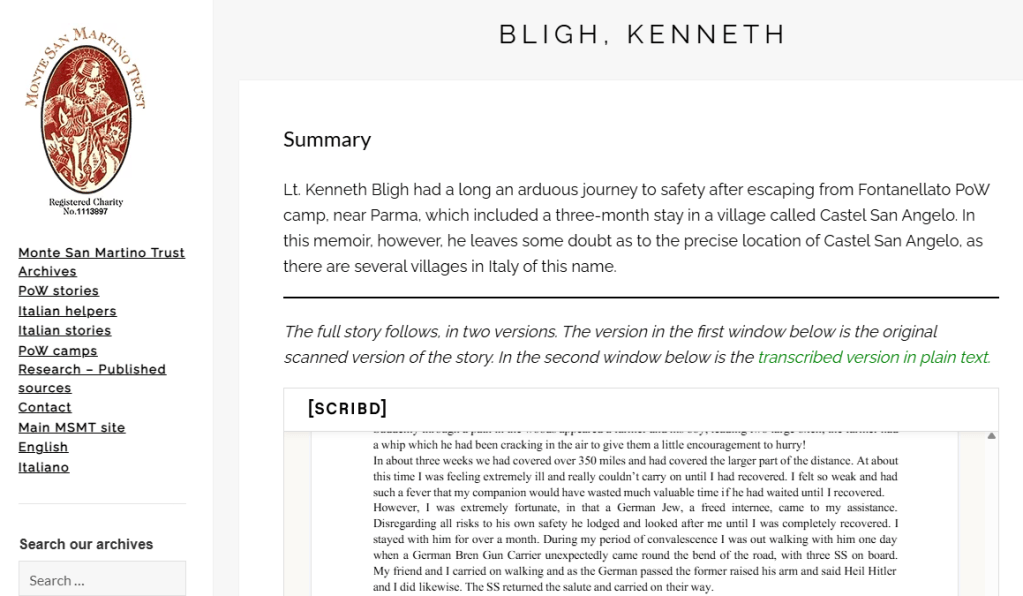
And it didn’t take long to hunt down the “brief account” of his father’s story that his Aunt had submitted to the Monte San Martino Trust (M.S.M.T.). A quick search for Bligh on the Trust’s fantastic search engine and hey presto….
Click Search and away you go!
But it appears that Patrick too sadly knew nothing of his father’s war time exploits “nor any details of his escape route or arrival at allied lines” as he explained when reaching out to me. However, it sounds as though he has made huge progress, largely with the help of the M.S.M.T. and with, as I have experienced, their most helpful staff:-
“The discovery that my father was in PG49 is complicated! I read Ian English’s obituary in The Times and this resulted in me buying his book Home By Christmas and, to my amazement, I saw my father’s name in the roll call in the back of the book [as is your father’s]as a prisoner in PG49. This led me to discovering the MSMT and through them I spoke to Keith Kilby and I then attended an MSMT lunch which led to me being on their mailing list and receiving their newsletters.
I went with my brother on the MSMT trip to Fontanellato in 2013 and stayed in an agriturismo with some of the officers of MSMT-Nick Young, Christine English and John Simkins. They were good fun and very committed to the charity. It was a great trip. There were over 100 attendees and the Italians were generous and welcoming hosts.”
And so I am able to confirm yet another POW who was in exactly the same place as my Dad in September 1943, and I’ve now got a living relative who no doubt shares the same feelings as I do about this incredible generation. And how wonderful to read this one excerpt from Kenneth Bligh’s submission that provides a very real sense of what each one of these men must have been feeling on that Autumn morning in 1943….
“It is hard to explain one’s reactions, walking through the wire, free and yet not free, that feeling of un-certainty, wondering what to do for the best, what the future is going to bring; whether to change into civilian clothes, if so would we be shot as spies, should we go north or south. (An) Immediate decision is the only thing in such a predicament and hope for the best.”
I close by saying to Patrick:-
“I’m so grateful to you for making contact as I think all of us must feel the same about this extraordinary period in our fathers’ lives. Especially as quite a lot of them seemed to not want to talk about it. Yet I have a tremendous sense of pride in how intrepid they all were, not just being prepared to go to war but also the fortitude to try and make their way home through enemy territory and in a very foreign land.”
I’m hoping that Patrick and I will continue to correspond, if only to see if we can add more pieces to this extraordinary jigsaw puzzle we both endeavour to complete. And perhaps we might even meet up in Fontanellato one day to celebrate the contribution that was made to making our lifetimes as peaceful and fulfilling as any might have experienced. We both think that an 85th Anniversary Celebration in Fontanellato in 2028 should be the next goal. As Patrick puts it:-
“I fear that if the next organised trip is not until 2033 there will not be many children of prisoners around to attend!”
Hang in there Patrick…. hang in there! Let’s do this!
On 27th August 2023 I ordered two books from the Naval & Military Press which I had posted to my brother Graham’s address in Sussex and, on my arrival there a month or two later, he was able to present me with a remarkable find.
In January 1942, during World War II, Benghazi in Libya changed hands twice. It was initially captured by Axis forces led by General Rommel on January 29th, having previously been taken by the British in December 1941. This recapture was part of a larger offensive by Rommel’s Afrika Korps, pushing back the British forces.
December 24, 1941: Benghazi was captured by the British during Operation Crusader.
January 23, 1942: Axis forces captured Agedabia.
January 29, 1942: Benghazi was retaken by Axis forces, marking a significant early victory for Rommel in his advance towards Egypt.
February 4, 1942: The front line stabilized between Gazala and Bir Hakeim.
May 26 – June 21, 1942: The Battle of Gazala took place, with Axis forces eventually capturing Tobruk.
June 28, 1942: Mersa Matruh, Egypt, fell to the Axis.
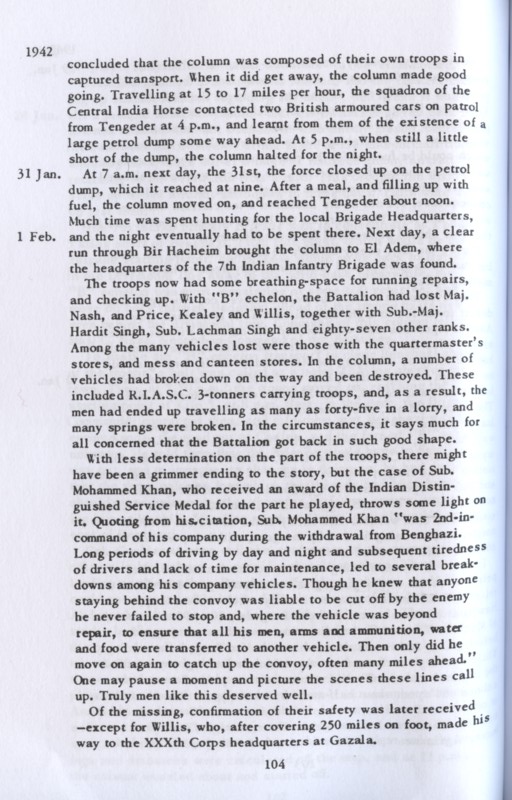
So, in January 1942, from pages 100 to 104 of the above book about The Sikh Regiment written by Colonel F.T. Birdwood, it appears that “B” Echelon of the 4th Battalion, comprising the undermentioned men, was overtaken by General Rommel and the Afrika Corps after the fall of Benghazi. This recapture of Benghazi occurred on January 29, 1942, after the British had initially taken it on December 24, 1941. The city’s strategic location made it a key objective in the back-and-forth struggle for control of North Africa during World War II.
On page 102 of the book under diary entry 28 Jan. – “Meanwhile, the “B” echelon transport, consisting of some 600 vehicles, was to move off back through Benghazi ahead of the troops to its new area behind the divisional line. Command of this column fell to Maj. C. Nash, Second-in-Command of the Battalion.” Later that night it was reported – “…..the fate of “B” echelon unknown.“ Then, on page 104 the diary entry of 1 Feb. reads – “The troops now had some breathing space for running repairs, and checking up.With “B” echelon, the Battalion had lost….“ (the following)
CAMP No.
NAME
INITIALS
RANK
ARMY No.
BOOK
35
Kealy
P.C.B.
2/Lt.
EC. 752
Page 104
29
Nash
C.S.
Maj.
284. IA
Page 102, 104
35
Price
R.F.
Capt.
EC. 282
Page 104
49
Willis
A.G.R.
2/Lt.
EC. 1357
Page 104
The final paragraph of p.104 brings welcome relief…. “Of the missing, confirmation of their safety was later received – except for Willis, who, after covering 250 miles on foot, made his way to the XXXth Corps headquarters at Gazala.“ My Dad had walked from Benghazi to Gazala!
A.G.R. Willis, Second Lieutenant – “Walked back from Bengazi (sic) after its fall, 27/01/1942, helped by Arabs, finally met by Captain Guard-Guillot of L.A.F..” Returned – 18/02/1942 (from the Nominal Rolls & Particulars of Escapers & Evaders, Middle East Jan 1941 – March 1945.)
I can’t recall exactly when but, sometime before my father died on 5th December 1998 and whilst he was still mobile (possibly in the 1980’s or 1990’s?), I vaguely recall asking him if he would like to visit the Western Desert on one of the Tours that were becoming popular for veterans and families. I’m not sure how he responded but, rather sadly, the suggestion never led to anything and I’m not sure whether he just couldn’t face that period in his life or, more likely, he just didn’t need to re-visit it.
Dad had experienced the most extraordinary life and this brief period of trauma between 1939 and 1945 (aged 23 to 29) was probably best transcribed to history. At the time I really wasn’t at all sure where I had hoped to take him, and on which tour of the Western Desert Campain he might associate himself with. Other than vague hints of El Alamein and possibly Mersah Matruh?
So, now that I’ve started this search for all these needles strewn all over these many haystacks that I am encountering, it has come as a bit of a relief that I am starting to find a few clues. None more so than the extraordinary amount of information being gathered by hundreds, if not thousands, of enthusiasts who all seem to have an amazing amount of interest and enthusiasm for researching and clarifying every minute detail of the events of World War II. Appropriately enough the information is being gathered under the website heading of WW2Talk.
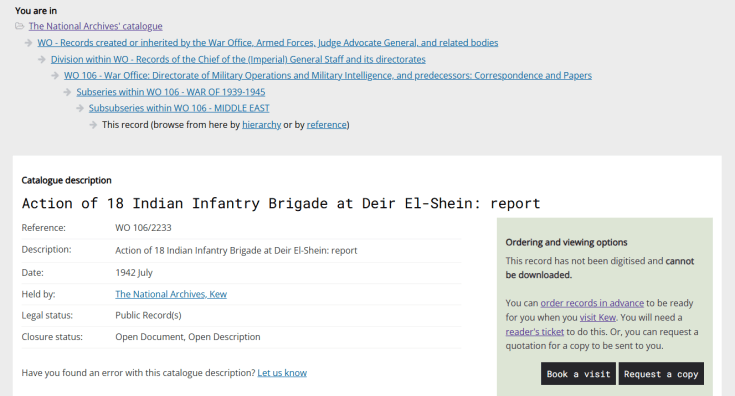
The major piece of work that has, and is continuing, to provide the most fulfilling reading has come from a ‘Thread’ entitled – Deir el Shein – July 1942. Essentially this information has been extracted from the Battalion Diary of the 4/11th Sikh Regiment (WO169/773) concerning an action in which the 18th Indian Infantry Brigade was overrun by German forces on 1st July 1942 at the beginning of the First Battle of Alamein.
On 28th August 2023 I had been astonished to read two references to my father in a Post I had called “Another piece of the Jigsaw“. But I had failed to continue reading this ‘Thread’, as I was probably in shock. But a little down the track and I’m once again scrolling through this incredible transcription of the Diary and I have one of those moments where the hair stands up on the back of your neck. The diary entry for 30 June 1942 DEIR SHEIN is providing details about the location of a number of military units in “BOXES”, including a New Zealand Division. But I’m afraid my limited military knowledge is not making this an easy read, although in this “BOX” at Deir el Shein there is:-
“2/5 Essex, 4/11 Sikh, 2/3 Gurkha Rifles, 66 Field Coy S & M, 4 medium M.G. manned by the Cheshires, 7 Matilda tanks manned by scratch crews from 42 R.T.R. while the arty (sic) consisted of 18 (?) 25 pdrs manned by 121 Field Regt & 79 Field Regt, approx 20 2 pdr A/Tk guns manned by unit’s, South Africans & some of the WELSH Regt also 16 (?) 6 pdr A/Tk guns manned by ? In addition of course was an ADS from 32 Field Ambulance & some S.A. sappers with compressors.”
Yes it says 4/11 Sikh. But I already knew that. It’s their War Diary! What comes next blows me away! Again!
Does that say that at midnight of 30th June 1942 my Dad was listed as a British Officer present with the Battalion at Deir el Shein? But the comment associated with the map below that one researcher provides brings a certain chill to proceedings.
“Begs the question of who put 18th Indian Brigade in that position? Presumably Willoughby Norrie, XXX Corps commander. Useful map showing the brigade out on a limb. Don’t quite understand the thinking of defending a depression rather than the high ground.“
As I start to read on I’m recalling a rather famous quote from a wonderful Harry Potter movie…. “BUCKLE UP, WE’RE IN FOR A BUMPY RIDE!!!”













 PG 49 at Fontanellato in Italy - The Story of allied servicemen who were held prisoner of war in this town in Italy in World War II