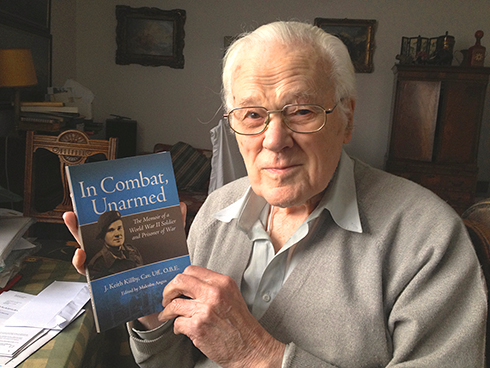
I have been very fortunate to have been provided with access to a book written by Keith Killby entitled “In Combat, Unarmed” and I was immediately gripped when I read the Foreword, written by Sir Nicholas Young, Chairman of the Monte San Martino Trust, in which he explained how he had been introduced to Keith Killby at a fairly informal gathering of men who had all been POW’s in Italy in World War II.
As he explained, most of them had all been in the camp (PG49) at Fontanellato where both my own father, and Nick’s, had been a POW, except Keith who had been in PG59 at Servigliano, and, on reading this excerpt, I too imagined myself in the same room “keeping very quiet, ears pinned back listening, shivers running up and down my spine.”
And how familiar the following words were to my ears when Nick Young went on to write….
“My father, at that time 12 years dead, had also been in Fontanellato; these men had known him, talked with him, escaped into the Italian countryside with him. He had never seen them again, had told hardly a soul indeed about his adventures.”
How I wish I had been in that same room and, I’m sure like Nick, how I wish that my father had been amongst this small group of men that we could have all shared in their joint stories of life in those camps, maybe how they had all been captured and all their adventures after being released from prison at the time of the Italian Armistice. As well as all the mishaps of their journeys through Italy and, in my father’s case, his recapture and imprisonment in Stalag VIIA, Moosburg in Southern Bavaria, Germany.
So now my task is to find these missing pieces of the jigsaw and piece them all together hopefully so that, one day, I will be able to tell my Dad’s story of his participation in World War II.
It was long after my father died that I started to become seriously curious about his involvement in World War II. I wonder in hindsight whether it was because I had instictively felt uneasy about raising or rather confronting him with these memories. Better still to leave sleeping dogs lie?
And it was only when my mother started having some real issues with her memory that I realised that I had to act urgently before it was too late.
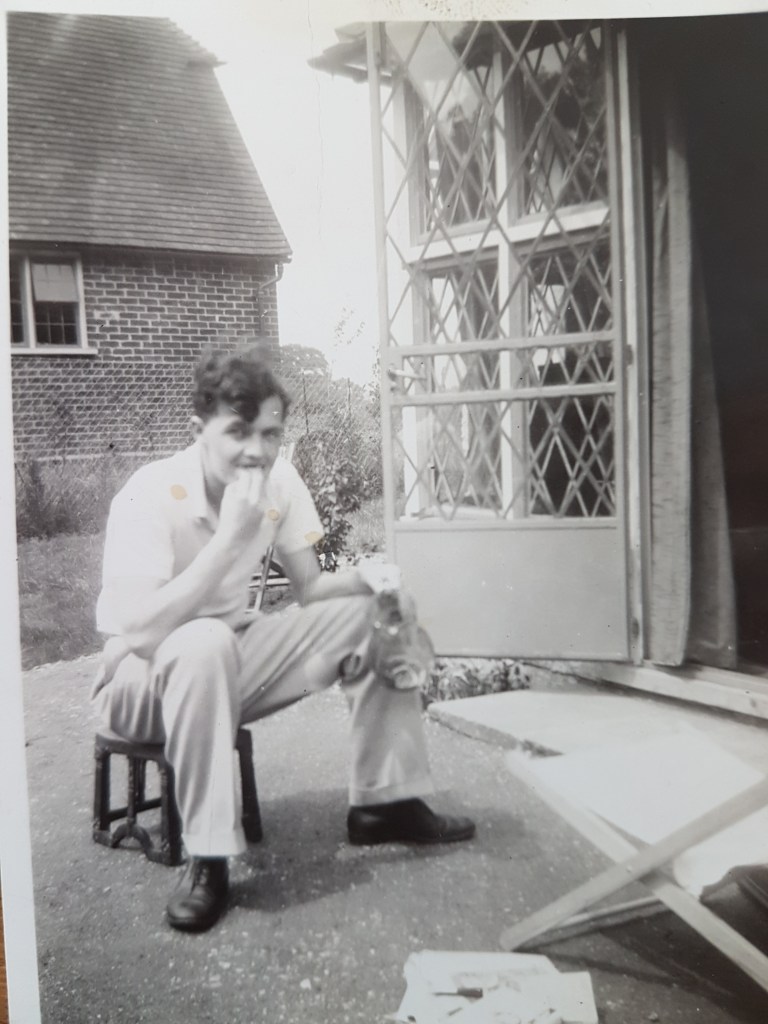
It was about the same time that I was able to talk with my eldest brother Graham about what he knew of our parents past and he very fortunately was able to provide me with digital copies of some of their very many photographs. So it was that I was able to see, possibly for the first time, my Dad soon after he had left school and at the age of 21 at his parents home in Clandon shortly before heading out to Ceylon to start a fascinating career in the Tea Industry.
Clandon 1937
As I recently wrote to Nick Young at MSMT describing my efforts to extract information from my Mum… “.. I am so grateful that I was able to extract that one place name from my Mum as she was slipping into dementia before she died. At the time that she told me that Dad was at Fontanellato I half imagined that she was mixing it up with some delicious Italian ice cream that she and Dad had both enjoyed!” But it has been the one singular word that has led me to so much.
In fact it initially led me to the Monte San Martino Trust, but it was actually my brother Graham, again, who unearthed the most astonishing fact, or rather facts, that Dad appeared in several of their documents when he used their search engine and typed in “Willis”.
The first story to pop up was that of Major Leslie Young of the 2nd Battalion Beds and Herts Regiment, none other than the father of Nick Young the Chairman and Trustee of the Monte San Martino Trust, in which Nick’s Dad wrote a diary entry simply stating “Willis and another passed through about 1700 hrs”. My very first evidence that Dad had been a POW in PG49 and was “On the Run” in Emilia-Romagna in September of 1943.
But was this my Dad? And who is Humphreys? The one fact I’m clinging to is I’m guessing that Keith Kilby, Founder of the Monte San Martino Trust and the person resonsible for initiating the collection of all of this information, had endeavoured to list all the names that appeared in the transcript and, thankfully, he had somehow established that this Willis was indeed Willis, 2nd Lt A – p.10. And continuing the investigation of the Archive only one other Willis pops up and appears to be that of Derek Willis who was in Padula (PG.35?) with Leslie Nathanson and Sulmona (PG.78) with Alan Hurst-Brown. So maybe it is my Dad!
But the second really worthwhile entry was that of Mike “The Forger” Goldingham (18 Cavalry, Indian Army) whose diary entries were compelling and re-inforced my few memories that I had of my Dad enjoying happy days with one particular Italian family during which he thoroughly enjoyed the grape harvest and treading the grapes with his bare feet!
An extract from Mike’s Diary:-
“This is the place to introduce you to the ‘Contadini’ without whose help, no POW would have been able to manage. Living in squalid farmhouses, with a few acres of land hacked out of the mountain side – a cow, sheep and hens, the Contadino is nearly self provident for his, often, large family. His wife — the women are the backbone of the country – rules the home and, with the children, works in the field equally hard as the men, and for the same hours. They are peasants, dirty, poor and ignorant, but they have the generosity of the east, so embarrassing to the Englishman. Many a time we have been forced to eat the family’s hot evening meal, while they contented themselves with dry bread.
We were four, all Indian Army, who stayed for six weeks in a small village near Bardi. We slept in a hay barn and fed with six families vying with each other in hospitality. As the Fascist Govt was extinct, the contadinis had not sent in their quota of flour, and there was plenty of bread. Gnocchi, Macaroni, pasta-asciutta, polenta, fungi, milk, grapes, chestnuts and cheese resulted in our fattening visibly in a short time. During the day we “helped” in the fields: (we could watch the main road, half a mile below, for a danger sign): hoeing potatoes, ploughing, cutting wood, collecting fungi or bringing in the grape harvest and squashing them with bare feet in a coffin-shaped vat. They were happy, sunny days.
We got on well with our hosts, and being able to draw a little, we had many female sitters. They made us realise that the term “a complexion like a peach” was not hearsay. To have put cosmetics on their cheeks would have been sacrilege. Our great friend was Marco, the village loper, who used to lock us in his cellar and force wine on us till we could take no more. We called wine “benzino”, saying we could not work without it. When hoeing, we put the bottle ahead of us, dig hard till level with it, and flop down with cries to our pretty companion, of “Maria, Benzino!” She produces glasses, serving us with smiles and charming courtesy, till we are ready to start again.
The cheese here was delicious – mostly Parmesan and a type of Gorgonzola. But to the Ites, the real delicacy is a cheese (we named it ‘Formaggio Artillieri’) that after three months becomes a squirming mass of worms. You can see and hear them jumping about (often amazing distances). A gourmet will go miles for a good mouthful of worms! A common dish is “polenta”, made from “grano turco” – Indian corn – mixed with milk and water, and cooked. When hot, the result, not unlike Yorkshire Pudding on a vast scale, is thrown bodily onto the wooden table-top, grated cheese and tomato sauce added, and we all sit round the mass, and plunge, every man for himself, into it with forks. It is rather tasteless, but excellent when made from chestnuts.
Nearly all the elder peasantry in the valley, and indeed throughout Italy, have either been to England or America, or have relations there. Our village boasted many who had been waiters, chefs, etc. in London, and in most houses the cutlery bore the names ‘Savoy Hotel’, ‘Piccadilly Hotel’ or ‘Romanos’! On Sundays, always heavy drinking days, used to be heard, from the cellars, snatches of “Rule Britannia” and “It’s a long way to Tipperary” sung with a strong Italian accent. Marco, when foxed, and consequently the children, used to shout, “Mussolini, Goddam, bloody, son of a bitch!”, the only English he knew! They all regard England and more so USA, as the land of milk and honey.
After six weeks of good feeding, drinking and laughter, we were no nearer freedom. Winter was coming and unless we moved over the mountains, we would get caught by the snow and be unable to move south till April. In addition, the Fascists were gaining power and prisoners their special quarry — only recently two officers with their 75 year old host were taken above this village. Our hosts were in worse danger than us, and four extra mouths was a lot to feed. The BBC was misleading – every day we expected the big attack and landings – and despite our hosts’ dissuasions and tears, John Meares and I left for the south.Paddy Bruen, whose boots were bad, and Andre Willis stayed behind. We heard, in July, that they got re-captured going to Switzerland.”




 PG 49 at Fontanellato in Italy - The Story of allied servicemen who were held prisoner of war in this town in Italy in World War II